Kasteel d'Ursel, Classical castle and museum in Hingene, Belgium.
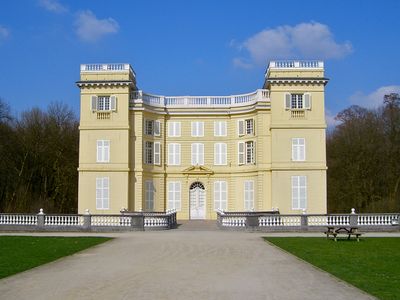
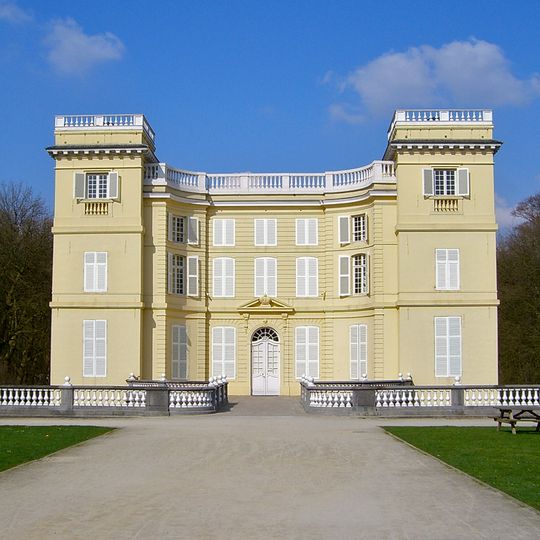
Kasteel d'Ursel is a three-storey neoclassical castle in Hingene, with a pale yellow facade, white trim and louvred shutters. Two projecting end pavilions with white balustrades flank a recessed central section topped by a curved balustrade. The central double doors have a fanlight beneath a triangular pediment.
A stone house ('steyne huys') bought in 1556 by Antwerp nobleman Dierick van de Werve became a maison de plaisance; Conrad Schetz acquired it in 1608 and made it a summer residence. In 1761–1765 Charles, 2nd Duke d'Ursel, had Giovanni Niccolò Servandoni rebuild it in neoclassical form with a symmetrical palace front. The province of Antwerp bought it in 1994 and restored it from 1995 to 2012.
The dukes celebrated family marriages together with the whole village of Hingene, and the castle hosted banquets and balls in the 18th century. Fifteen rooms have walls covered with chintz painted or printed in India or Europe, the oldest pieces dating from the mid-17th century. Chinese wallpaper hangs in the small antichamber of the quartier de la belle alcove, with trees, flowers, birds and butterflies on a light blue ground.
The castle is in Hingene, part of Bornem, on the old border between the Duchy of Brabant and the County of Flanders. The large park with a youth hostel centre and the hunting pavilion De Notelaer on the Scheldt are publicly accessible. The Casteleyn, once a coach house (1804) and gatekeeper's lodge (1906), was sold to the province of Antwerp in July 2022 and is being renovated.
The former painting studio of Antonine De Mun (1849–1931) dates from 1877 and was restored in 2018 as a holiday home. Its furnishing was paid for by sales of two regional beers, Cuvée Antonine Bruin and Cuvée Antonine Blond, brewed by the castle with Brouwerij Den Triest.
The community of curious travelers
AroundUs brings together thousands of curated places, local tips, and hidden gems, enriched daily by 94,354 contributors worldwide.