Losk Castle, Castle in Belarus
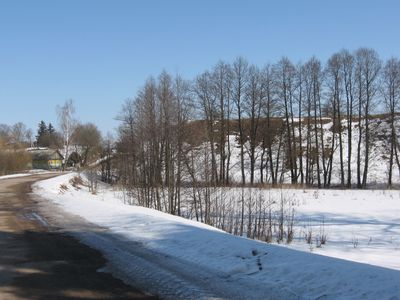
Losk Castle was a wooden defensive structure that stood from the 14th to the 18th century on a natural hill between the Kozlovka and Veresovka streams near the village of Losk. A 1621 inventory records ten three-tiered towers linked by log walls, a two-tiered gate tower with a portcullis, and two two-storey palaces inside a ring-shaped earthen rampart. Today only the oval castle mound, about 75 by 160 metres and 12–15 metres high, remains.
The wooden castle existed from the 14th to the 18th century on a hill between the Kozlovka and Veresovka rivers. It belonged to the outer defense ring of Vilnius together with the stone Kreva Castle. It was probably built by Duke Kaributas Algirdaitis. A 1621 inventory records ten three-tiered towers and a gate tower with a portcullis.
The castle's name comes from the small town of Losk, whose castle hill still rises on the southeastern edge of the village. The 1621 inventory records a kitchen near the gate tower and, outside the walls, a bathhouse and a brewery, showing that the fortress also served everyday needs. Excavations in 1987–1991 uncovered a cultural layer 1–2 m deep.
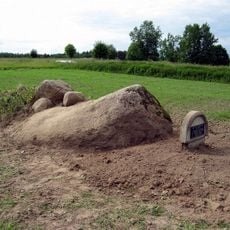
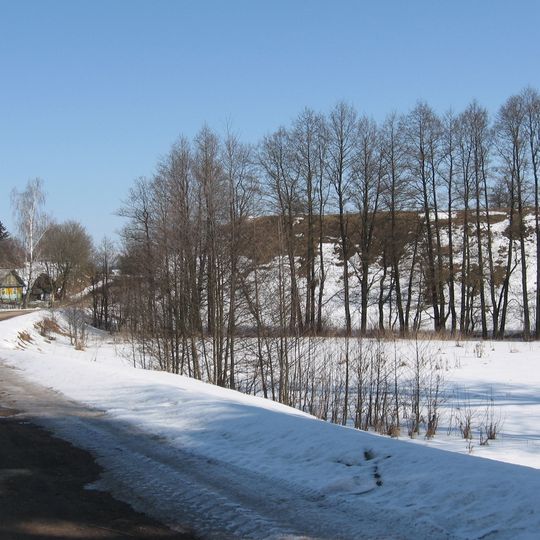
The castle hill is an oval mound 75 by 160 metres and 12 to 15 metres high on the south-eastern edge of Losk village. Its slopes have eroded, so approach with care. Excavations in 1987–1991 uncovered about 400 square metres of a 1–2 metre cultural layer; no walls or towers stand today.
The castle hill still stands at the southeastern edge of Losk village: an oval platform 75 by 160 m, 12–15 m high, with slumped slopes. Archaeologists excavated about 400 m² here, with a cultural layer 1–2 m deep; Yury Bokhan later summarized the findings in his dissertation and monograph.
The community of curious travelers
AroundUs brings together thousands of curated places, local tips, and hidden gems, enriched daily by 95,467 contributors worldwide.