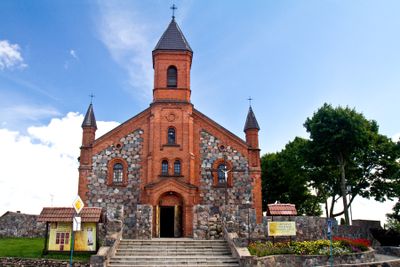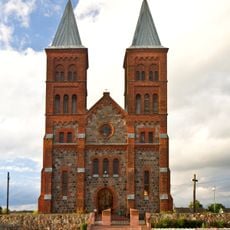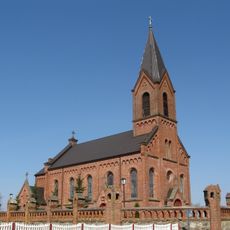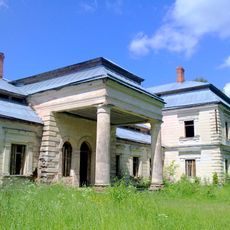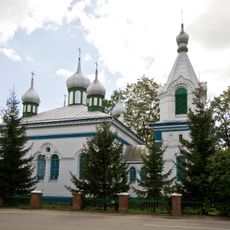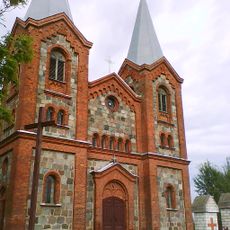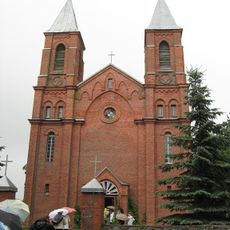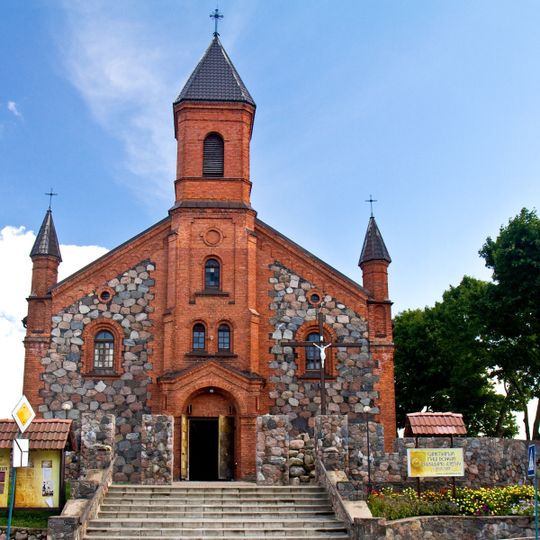
Church of the Nativity of the Virgin Mary in Braslaŭ, Catholic church in Braslaŭ, Belarus.
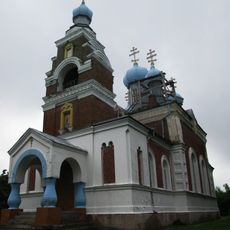
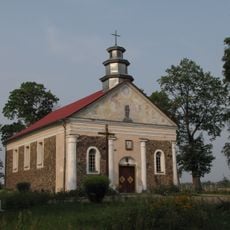
The Church of the Nativity of the Virgin Mary is a stone church built in 1824 at the foot of Castle Hill and rebuilt in 1897. It has a single three-storey tower at the front, stepped buttresses, pinnacles and an arcaded frieze. The east and north walls preserve the 1824 masonry, decorated with the local "raisin" technique: small stones set into mortar around large blocks in geometric patterns, including 29 sun or flower motifs.
A first Catholic church was built in Braslaŭ in 1423 by Vilnius voivode Monwid; King Alexander funded a replacement after a fire in 1504. The present stone church was completed in 1824 at the foot of the castle hill, rebuilt and enlarged in 1897, and consecrated in June 1906 by Bishop Gaspar Cyrtowt. Closed on 11 October 1949 and used as a grain store, it reopened on 24 October 1952.
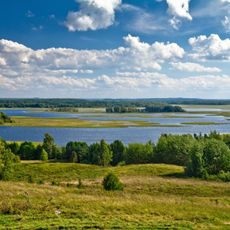
The main altar holds the icon of Our Lady of Braslaŭ, called Queen of the Lakes and venerated as patroness of the Braslaŭ lakes. According to tradition it came from a Basilian monastery on Lake Nieśpisz, 3 km away, destroyed by fire in 1832; the image survived and was placed here. Papal crowns blessed by Benedict XVI in 2009 were placed on it that August.
The building is located in central Braslaŭ and can be easily reached on foot from the city center. As an active place of worship, visitors should respect service times and approach with appropriate reverence.
The stone east and north walls survive from the 1824 building and carry a local technique called "raisin work": small pebbles are pressed into the mortar around large fieldstones in geometric patterns, mostly suns and radiating flowers. There are 29 such panels, also found on churches, water mills and estate buildings across the Braslaŭ region.
The community of curious travelers
AroundUs brings together thousands of curated places, local tips, and hidden gems, enriched daily by 94,218 contributors worldwide.