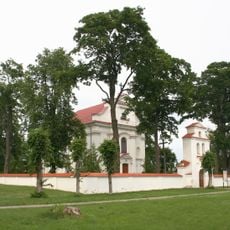
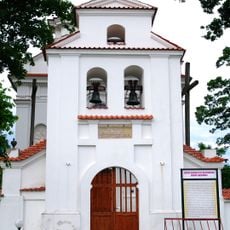
Church of the Holy Trinity in Voŭčyn, Baroque Catholic church in Voŭčyn, Belarus.
The Church of the Holy Trinity is a late-Baroque stone church built on a central octagonal plan and covered by a faceted hipped roof. A low porch marks the entrance, while the wide faces are framed by paired Corinthian pilasters and topped by segmental pediments with sculptures of the Evangelists and rocaille vases. A small belvedere with a chiming clock crowns the roof.
The parish was founded in 1639; the first wooden church, funded by Aleksander Gosiewski, stood by the road to Vysokaye and was ruined in the Great Northern War. Stanisław Poniatowski and Konstancja Czartoryska built the present masonry church: the cornerstone was laid on 18 July 1729, walls rose in 1730–1731, and it was consecrated on 21 July 1743. Their son Stanisław August, the future king, was born at Voŭčyn in 1732 and baptised here.
The church was consecrated on 21 July 1743 by Bishop Franciszek Antoni Kobielski under the title of the Holy Trinity, the Visitation of the Virgin Mary and St Stanislaus. In 1761 it hosted the weddings of Adam Kazimierz Czartoryski to Izabella Flemming and of Aleksandra Czartoryska to Michał Kazimierz Ogiński, both celebrated by Bishop Teodor Kazimierz Czartoryski.
The church stands on the axis between the former palace complex and the town, with the brick plebania (presbytery) east of the churchyard. The building is an octagonal rotunda, not a twin-towered facade, so walk around it to see the three tiers of windows and the pilasters on each face.
The church is the only surviving part of the former Poniatowski palace complex; the future king Stanisław August was born here in 1732. Its eight-sided plan is topped by a belvedere with a chiming clock, destroyed in 1939 and rebuilt in the 2010s. From 1938 to 1989 the remains of the last king of Poland lay in the crypt, which was looted in the 1950s.
The community of curious travelers
AroundUs brings together thousands of curated places, local tips, and hidden gems, enriched daily by 94,989 contributors worldwide.