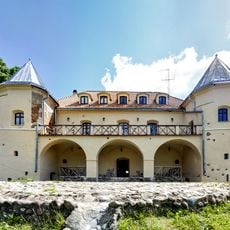
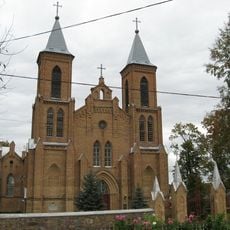
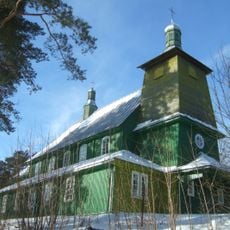
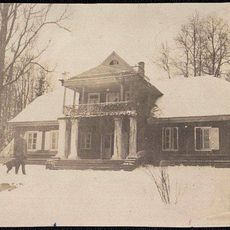
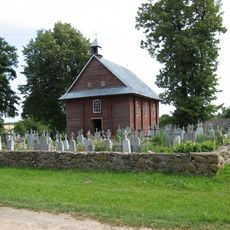
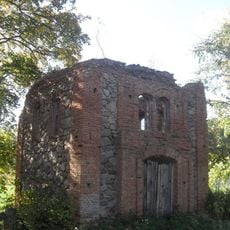
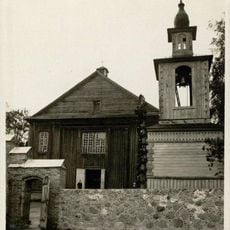
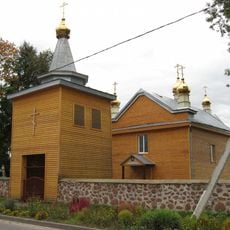
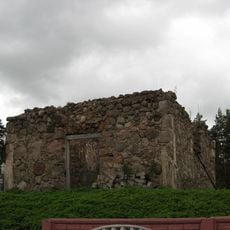
St. John the Baptist Church, Catholic church building in Halshany, Belarus.
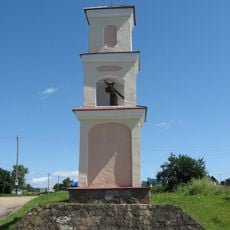
St. John the Baptist Church is a three-nave baroque church with a towerless main facade topped by a curved pediment, built in the 1770s on older foundations. Its flat presbytery wall carries a late-18th-century trompe-l'œil painting imitating a three-tiered altar and a dome. A two-storey monastery wing adjoins the church on the northwest, and a separate square bell tower from the 1810s stands in front.
Paweł Stefan Sapieha, deputy chancellor of Lithuania, invited the Franciscans to his ancestral estate in 1618 and founded the monastery; the church was built on the foundations of a former Calvinist church. In the early 1770s (probably around 1774) it was dismantled almost to the walls and rebuilt in baroque style using the old foundations. The monastery was dissolved by decree on 19 July 1832 after the 1830–31 uprising, and the church became an ordinary parish church.
The church keeps the name of its founder's family: Paweł Stefan Sapieha brought the Franciscans here in 1618, and he and his wives were buried inside. A local legend tells of the White Lady, a woman said to have been walled up alive in the monastery wall; in the 1990s restorers clearing the cellars found a female skeleton beneath one wall.
You can explore the grounds on foot during daylight hours and view the buildings from outside. It helps to visit in clear weather when you can see the architectural details clearly.
The monastery's residential wing, two storeys and rectangular in plan, adjoined the church on the north-west; a gallery around the cloister, partly destroyed in 1832, once linked the two. Archaeologist A. Kushnyarevich found the foundation of a second hexagonal tower opposite the surviving one. In the 1990s restorers clearing the cellars found a woman's skeleton beneath a wall, which locals linked to the White Lady legend.
The community of curious travelers
AroundUs brings together thousands of curated places, local tips, and hidden gems, enriched daily by 94,576 contributors worldwide.