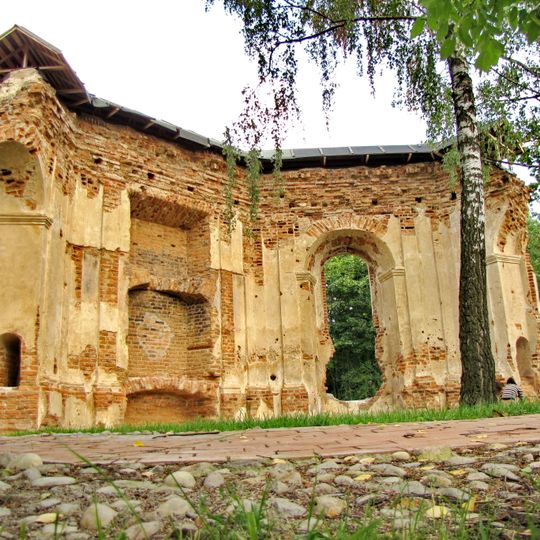
Lubanski family tomb chapel in Lošyca, Sepulchral chapel in Lošyca, Belarus.
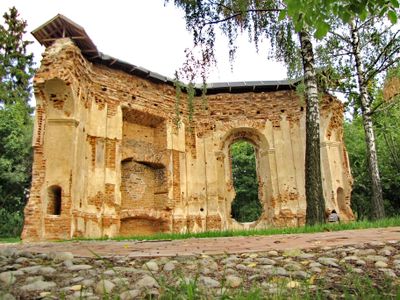
The Lubanski family tomb chapel stands on the grounds of Łošyca estate and displays traditional architectural features of 18th-century Eastern European religious buildings. The structure combines elements of a church with a tomb monument, serving both as a place of prayer and as a resting place for the dead.
A stone church consecrated to the Assumption of the Virgin Mary was probably founded by Józef Pruszyński; inventories of 1769 and 1772 date its construction to 1769. His son Stanisław Ksawery Pruszyński, owner from 1779, repaired and decorated it and, with the Vilnius bishop's permission, installed the altar in 1787. Until the mid-19th century documents call it a kościół, later a chapel; in 1944 retreating German troops blew it up with stored ammunition.
The building was called a church in manuscripts until the mid-19th century; later inventories renamed it a chapel. In 1884 the Polish Geographical Dictionary noted that services had not been held there for many years. The 1818 inventory records a single wall altar with a painted image of the Virgin Mary, four votive tablets, a stone mensa and a wooden confessional.
The ruins stand on a hill to the right of the entrance avenue, near the estate gate, among black pines (Pinus nigra). The site is unroofed and uneven; stay on the paths and do not climb the masonry. Conservation work by Projectrestavratsiya was planned, so access may be limited.
The chapel was blown up by retreating German troops in late June 1944 with ammunition stored inside; only the ruins survive. In the 1990s conservation projects were drawn up by architect A. Malakhovsky and later by the firm Proektrestavratsiya, but restoration was never carried out.
The community of curious travelers
AroundUs brings together thousands of curated places, local tips, and hidden gems, enriched daily by 94,427 contributors worldwide.