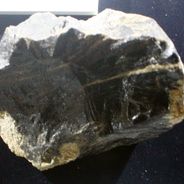
Mistastin crater, Impact crater lake in Labrador, Canada
Mistastin crater is an impact structure in Newfoundland and Labrador, Canada, about 28 km (17 mi) across, holding the roughly circular Mistastin Lake, which is about 16 km (9.9 mi) in diameter. The lake contains Mishta-minishtikᐡ, an arcuate central island interpreted as the crater's central uplift. The surrounding land is grooved grey-brown rock with patches of green vegetation.
The Mistastin impact occurred about 36.6 million years ago, in the Eocene. The target rocks were part of a batholith of adamellite, mangerite and anorthosite lenses. Cubic zirconia around the crater rim indicates impact temperatures above 4,300 °F (2,370 °C), the highest crustal temperatures known on Earth. The lake was first identified as a possible impact crater in 1968 after being viewed from space.
The site is located within the traditional hunting grounds of the Mushuau Innu First Nation near the Quebec border, and visiting requires permission out of respect for the cultural significance of the region.
Access to the crater requires preparation for remote wilderness conditions and rugged terrain, and visitors should arrange permission with the Mushuau Innu First Nation before traveling to this isolated Labrador location.
The crater's rim holds cubic zirconia, formed when the impact heated crustal rock above 4,300 °F (2,370 °C), about 43% of the Sun's surface temperature. The lake's arcuate central island, Mishta-minishtikᐡ, is the crater's central uplift, and its rocks show planar deformation features, diaplectic glass and shatter cones.
The community of curious travelers
AroundUs brings together thousands of curated places, local tips, and hidden gems, enriched daily by 93,846 contributors worldwide.