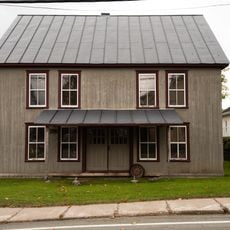
Manoir Taschereau, Manor house in Sainte-Marie, Canada
Manoir Taschereau was a seigneurial manor built between 1809 and 1811 at 730 rue Notre-Dame Nord in Sainte-Marie, about 1.2 km from the town centre. Its main facades were re-clad in the 1940s by Rémy-Georges Taschereau, giving it the American-influenced neoclassical look it kept until its destruction. An interior fire on the night of 2 February 2021 caused the inside to collapse, and the remains were razed on 18 November 2021.
Built between 1809 and 1811 for seigneur Jean-Thomas Taschereau on land granted by his father Gabriel-Elzéar, the manor became the Taschereau family seat at Sainte-Marie. In 1876 Jean-Thomas Taschereau, then a Supreme Court judge, bought it back from his sisters. Around 1900 greenhouses were added, and in the 1940s Rémy-Georges Taschereau refaced the main façades in a neoclassical American style. It was destroyed by a suspicious fire in February 2021 and the remains were razed on 18 November 2021.
The manor represents how wealthy families in early Canada adopted European architectural styles to express their status and cultural refinement. The symmetrical design and classical proportions were ways to demonstrate learning and success in the new land.
The manor no longer stands: its remains were razed on 18 November 2021 after the fire of 2 February 2021, so there is no facade to see at 730 rue Notre-Dame Nord. The site lies about 1.2 km from downtown Sainte-Marie, near the Chaudière river, which flooded the grounds in 2019.
The property blends European design principles with local materials and construction techniques available in early Canada. This fusion demonstrates how builders had to adapt classical styles to the resources and climate of a new territory.
The community of curious travelers
AroundUs brings together thousands of curated places, local tips, and hidden gems, enriched daily by 93,850 contributors worldwide.