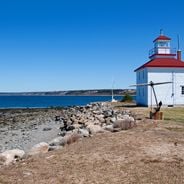
Cape Bonavista Light, Historic lighthouse on Cape Bonavista, Newfoundland and Labrador, Canada
Cape Bonavista Light is a two-story wooden building with a square plan, 9 by 9 metres, built around a 9-metre cylindrical masonry tower topped by a gallery and lantern. Its exterior is painted in vertical red and white stripes. A two-story keeper's house with a mansard roof, added in 1885, is linked to the lighthouse by a covered passage.
Built between 1841 and 1843 to mark the entrances to Bonavista and Trinity bays and guide mariners bound for Labrador, it is Newfoundland's fourth-oldest lighthouse. Its first lamps and reflectors came from Scotland's Bell Rock lighthouse; Robert Oke, first Chief Inspector of the Newfoundland Lighthouse Service, installed both that apparatus and the later catoptric system from the Isle of May. The light went dark in 1962, replaced by an electric light on a nearby steel skeleton tower.
The lighthouse has been a provincial museum since the 1970s, restored to its pre-1870 appearance. Inside are furniture and artifacts from that period, plus exhibits on coopering, fishing, whaling and sealing, and the ecological history of Cape Bonavista. The rare catoptric system of Argand oil lamps and polished silver parabolic mirrors is also on display.
The lighthouse stands on Cape Bonavista at the end of the road; the museum occupies the 1843 building, while the automated light works from the steel skeleton tower built beside it in 1966. From the gallery you can watch for whales, icebergs and puffins. Paths on the headland are uneven and windy, so wear sturdy shoes.
The light apparatus on display is a catoptric system of Argand oil lamps and parabolic mirrors of polished silver, not a Stephenson reflector. It came from the Isle of May in Scotland and was installed at Cape Bonavista by Robert Oke, the first Chief Inspector of the Newfoundland Lighthouse Service.
The community of curious travelers
AroundUs brings together thousands of curated places, local tips, and hidden gems, enriched daily by 92,633 contributors worldwide.