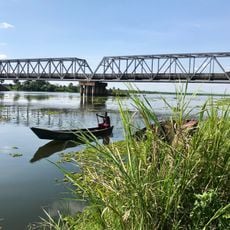
Lake Albert, Freshwater lake between Uganda and Democratic Republic of the Congo
Lake Albert is a freshwater lake on the border between Uganda and the Democratic Republic of the Congo, about 160 km long and 30 km wide, with a maximum depth of 51 m at 619 m above sea level. It is the northernmost lake in the Albertine Rift, with the Rwenzori Mountains to the south and the Blue Mountains to the northwest. Its southern end receives the Semliki River and has swamps, while the Victoria Nile enters from the southeast and the Albert Nile leaves at the northern tip.
European explorers first reached this water body in the mid-1800s and brought it to international attention. The lake had long been central to the region before outside documentation began.
Local communities have lived by these waters for generations, relying on them for food and trade. The lake shapes daily rhythms and remains central to how people here earn their living.
The lake's outlet at its northern tip is the Albert Nile, and the settlements on the shore include Butiaba and Pakwach, which serve as starting points for reaching the water. The Rwenzori Mountains lie to the south and the Blue Mountains to the northwest. Swamps border the southern end where the Semliki River enters.
The SS Robert Coryndon, a cargo and passenger ship built in 1930 by John I. Thornycroft & Company in Woolston, Hampshire, lies partly submerged at Butiaba landing site. Winston Churchill called it "the best library afloat" and Ernest Hemingway "magnificence on water". It was scuttled in 1962 or sank in 1964 and has never been salvaged.
The community of curious travelers
AroundUs brings together thousands of curated places, local tips, and hidden gems, enriched daily by 92,617 contributors worldwide.