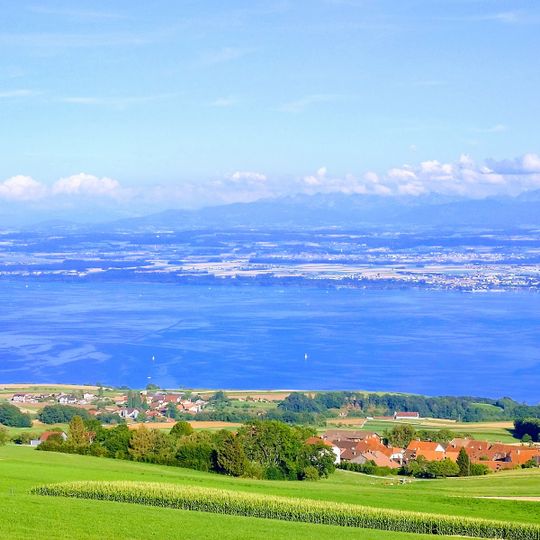
Lake Neuchâtel, Alpine lake in Romandy, Switzerland
Lake Neuchâtel is the largest lake lying entirely within Switzerland, with a surface of 218 km², a length of 38 km and a maximum depth of 153 m at 429 m above sea level. It sits at the foot of the Jura Mountains, between the cantons of Neuchâtel, Vaud, Fribourg and Bern, and is linked by canals to Lake Biel and Lake Morat.
The ancient La Tène site on the northern shore holds major archaeological importance, showing traces of people who lived here over 2000 years ago. Its discoveries helped define an entire period of European history.
The lake's shores are shared by four cantons: Neuchâtel, Vaud, Fribourg and Bern. The La Tène culture, named after the site at La Tène on the northern shore, refers to the Iron Age finds made there. Around the lake, wine trails link villages such as Auvernier and Cortaillod, and the Clendy megaliths near Yverdon-les-Bains stand as prehistoric remains.
Regional boats run throughout the year between different lakeside locations, offering a good network for visitors and residents to travel. The best time to explore is from late spring through early autumn when weather is milder and more stable.
The Thielle canal carries the lake's outflow to Lake Biel; the lake's water is renewed roughly every 8.2 years. Around its shores lie the wine routes and the Clendy megaliths at Yverdon, and the La Tène pile-dwelling remains that gave their name to the La Tène culture.
The community of curious travelers
AroundUs brings together thousands of curated places, local tips, and hidden gems, enriched daily by 93,076 contributors worldwide.


