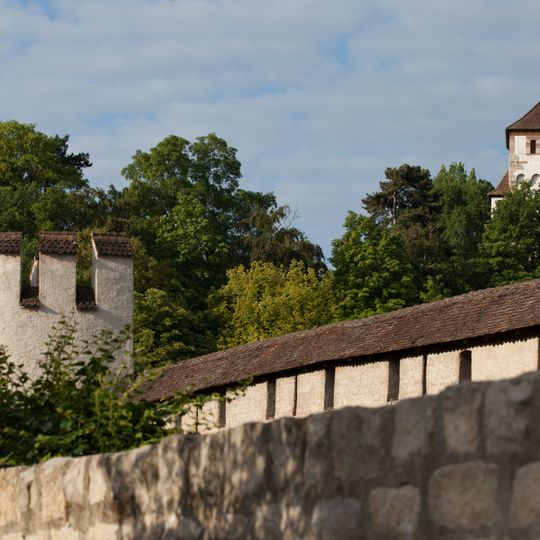
Walls of Basel, Medieval city walls in Basel, Switzerland
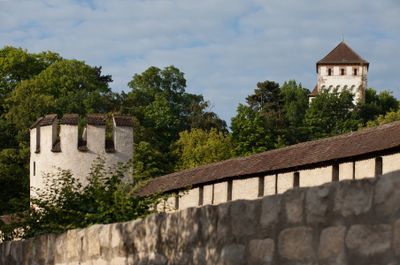
The Walls of Basel are medieval fortifications surrounding the city center, preserved in several sections along with three distinctive gates: Spalentor, Sankt-Alban-Tor, and Sankt-Johanns-Tor. These elements form a system of stone walls and passages that trace the outer boundaries of the historic settlement.
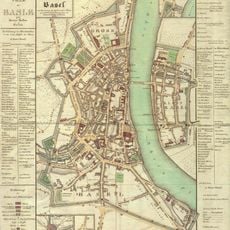
The first wall was completed around 1080 under Bishop Burkhard von Fenis; a replacement, the Inner Wall, followed around 1230 and enclosed roughly 32 hectares over almost 1600 m. Construction of the Outer Wall ran from 1362 to 1398, more than doubling the length to about 4 km and the enclosed area to 120 ha. Basel's councils decided in 1859 to demolish the walls, and only three outer gates and a short wall section were kept.
The gates gave their names to the streets that replaced the walls: Aeschentor, Steinentor and Rheintor survive as addresses in the old town. The Spalentor, flanked by two round towers, carries three statues on its outer facade — the city patron Mary and two prophets. Ten gravestones from Basel's first Jewish cemetery, destroyed in 1348, are displayed in the courtyard of the Jewish Museum of Switzerland.
Of the walls, only three outer gates and a short wall section survive: Spalentor, Sankt-Alban-Tor and Sankt-Johanns-Tor. The gates stand apart from one another, so plan a route that links them rather than expecting a continuous walk along the fortifications.
The outer walls incorporate debris from the 1356 earthquake, showing how construction relied on salvaged materials from local disasters. Stones from destroyed Jewish gravesites were also built into the fortifications, a silent record of past upheaval.
The community of curious travelers
AroundUs brings together thousands of curated places, local tips, and hidden gems, enriched daily by 93,077 contributors worldwide.