Nydeggbrücke, Stone arch bridge in Bern, Switzerland
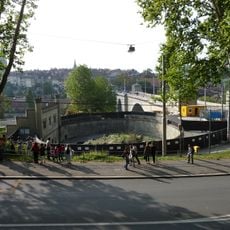
The Nydeggbrücke is a freestone bridge of three arches over the Aare, linking the Nydegg area of Bern's old town with the bank by the Bärengraben. Its core is Merlinger and Jura limestone from Solothurn, clad in blue sandstone from Ostermundigen. The central arch spans 46 m, the side arches 16.5 m each, and the pillars are 14 m wide.
The Nydeggbrücke was built between September 1840 and November 1844 by Uri contractor Karl Emanuel Müller, who had also built the second Teufelsbrücke at the Gotthard. The keystone of the main arch was set on 15 September 1843 amid cannon fire, and the bridge opened on 23 November 1844. Tolls stayed far below expectations and were abolished on 1 March 1853, when the canton took over the bridge.
The bridge is named after the Nydegg quarter and church at its western end, the site of the medieval Nydegg castle that gave the lower old town its name. The two pavilions at the ends were planned as toll houses; after internal tolls were abolished on 1 March 1853 they lost that role and the canton took over the bridge.
The bridge carries road traffic and has narrow pavements on both sides; the roadway narrows from 10.5 m at the ends to 7.5 m over the 124.3 m central stretch. The Nydegg end sits by the Nydeggkirche in the old town, the far end by the Bärengraben. The top of the bridge is 25 m above the average river level.
The bridge's main arch, with a span of just under 46 metres, was the largest in Europe until the 1890s. The structure rests on pillars 14 metres wide, and the bridge deck narrows from 10.5 metres at the approaches to 7.5 metres over the river. The bridge is listed as a class A Swiss cultural property of national significance.
The community of curious travelers
AroundUs brings together thousands of curated places, local tips, and hidden gems, enriched daily by 94,226 contributors worldwide.