Creugenat, Karst spring in Haute-Ajoie, Switzerland
Creugenat is a karst spring in Haute-Ajoie, Switzerland, forming part of a cave system extending about 2.5 kilometers. The water drains from a catchment area of roughly 48 square kilometers across the Jura region.
Scientific study of the water outbursts began in the late 18th century. In 1933 speleological work started, and in 1934 divers from Zurich reached about 60 metres before the cave was pumped dry, confirming that the Beuchire in Porrentruy is fed by this system. Exploration resumed in 1973; by late 1974 over two kilometres of galleries were surveyed.
The name comes from local Jura dialect and refers to a small depression or the action of digging into the earth.
The cave entrance lies at the foot of a roughly 15 m deep doline in a dry valley near Chevenez, on the territory of Haute-Ajoie. Access to the cave is not permitted to the public for safety reasons, and the flooded galleries are reserved for cave divers. The site is best observed from outside during or shortly after a flood, when the Ajoulote emerges and flows toward the plain of Courtedoux.
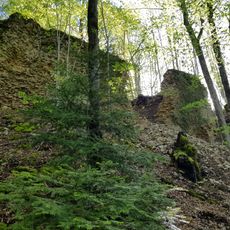
The name is often said to mean "witches' hole" in Jura dialect, but archive research suggests it comes from a word for a small hollow or the verb "to dig", linked to the labourers who built a retaining wall whose remains are still visible in the estavelle.
The community of curious travelers
AroundUs brings together thousands of curated places, local tips, and hidden gems, enriched daily by 95,021 contributors worldwide.