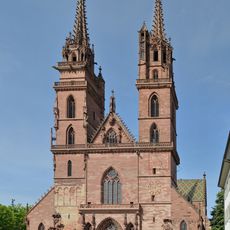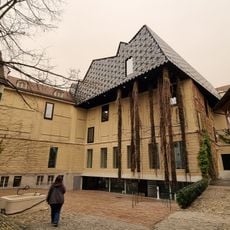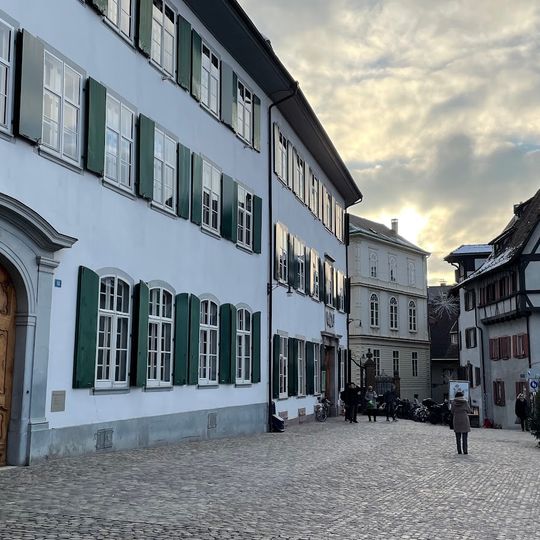
Münsterplatz, Cathedral square and pedestrian zone in Basel, Switzerland
Münsterplatz consists of two parts: the roughly square, tree-planted Kleiner Münsterplatz north of the minster, and the long Grosse Münsterplatz running in front of the west facade. The paving of flat Rhine stones, split and set with the broken edge upward, dates from the late 14th and early 15th century. A marked former Roman draw well lies in the northern section, and the Pisonibrunnen of 1784 stands in the southwest corner of the small square.
The square took its present form in stages: during the medieval construction of the minster, again in the Baroque period, and finally in the early 19th century. Its stone paving dates from the late 14th and early 15th centuries and already existed when the Council of Basel opened in 1431. On 24 July 1440, the council elected antipope Felix V in the Haus zur Mücke on the square.
The square was the centre of medieval Basel life, hosting religious processions, festivals, tournaments and royal ceremonies; the early Basel carnival also took place here until it was banned. The Kleine Münsterplatz once had a court lime tree, and until 1521 the newly elected councillors were sworn in there in the presence of the bishop. Today the square is a residential area with no shops.
No tram or bus line runs across Münsterplatz or right next to it, so access is on foot via Rittergasse, Augustinergasse, Münsterberg or Schlüsselberg. The square was not car-free until 2007. Below the Pfalz platform, a stairway leads down to the Münsterfähre landing on the riverside promenade called Fähribödeli.
From certain spots on the square, views open toward the Rhine riverbank, offering rare glimpses across the old city center toward the water. This connection links the plaza visually to the river that shapes Basel's geography.
The community of curious travelers
AroundUs brings together thousands of curated places, local tips, and hidden gems, enriched daily by 92,684 contributors worldwide.