Dinosaur plate of Lommiswil, Paleontological site in Lommiswil, Switzerland
The Dinosaur plate of Lommiswil is a roughly 10,000 m² limestone slab in a quarry of the Bürgergemeinde Bellach, on the ground of Oberdorf SO. It bears 313 sauropod footprints in nine trackways: horseshoe-shaped front prints about 60 by 40 cm and oval rear prints about 120 by 80 cm, with step lengths of 2.5 to 5.2 m. The slab is not walkable because of its steepness and rockfall risk; an observation platform with information boards stands at the quarry.
The plate is about 145 million years old, from the early Kimmeridgian, dated by ammonites in the Solothurner Schildkrötenkalk. The sauropods walked across lime-mud pools that were flooded only at high tide; an algal layer then protected the prints. Later sedimentation, pressure and cementation fossilised them, and the folding of the Jura lifted the plate. Quarrying exposed it, and in 1987 the traces were recognised as dinosaur footprints.
The limestone formation, known as Solothurner Schildkrötenkalk, holds fossils of turtles, sea urchins, fish, crustaceans, and conifer plant remains from the Jurassic period.
The plate lies in the quarry of the Bürgergemeinde Bellach above Lommiswil, on Oberdorf soil. Reach it on foot in about 20 minutes from the Oberdorf–Weissenstein chairlift valley station or the BLS stop Im Holz. An observation platform with information boards stands at the quarry; the plate itself cannot be walked on because of its steepness and rockfall risk.
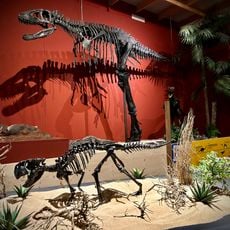
The plate itself cannot be walked on because of its steepness and the risk of falling rocks; visitors view it from a platform with information panels at the quarry. Walkable copies of the footprints and an exhibition are held at the Natural History Museum in Solothurn.
The community of curious travelers
AroundUs brings together thousands of curated places, local tips, and hidden gems, enriched daily by 94,457 contributors worldwide.