Mont-Terri, Archaeological site and medieval castle ruins at Mont Terri, Switzerland
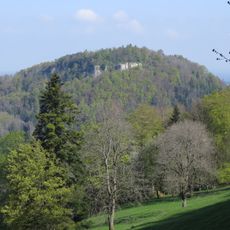
Mont-Terri is an archaeological site with medieval castle ruins on a plateau at 804 meters elevation, surrounded by steep cliffs and protected by ancient fortifications. The approximately four-hectare area displays remains of settlements from various historical periods.
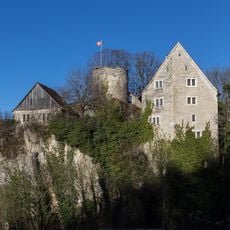
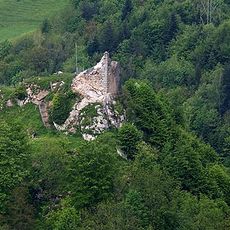
Neolithic flint artefacts and polished axes mark the first use of the summit, followed by occupation in the Middle and Late Bronze Age. In the 1st century BC a Murus Gallicus rampart of timber framing filled with stone and earth was built on the north and east sides; the only firm dating is a Roman coin from Augustus' reign. A stone tower, probably the "Château Thierry" of contemporary texts, replaced a wooden one in the 13th century.
Locals call the summit "Camp de Jules César", after Father Pierre-Joseph Dunod's 1716 claim that Caesar defeated Ariovistus's Suebi there. Finds include Italian wine amphorae, fibulae, a bronze wine strainer and a coin series ending with Magnus Decentius (351–353 AD).
The site sits on a plateau with good views and can be explored on foot, though steep paths require sure footing. Visitors should bring appropriate footwear and allow enough time to see both the archaeological remains and the castle ruins.
The summit is known locally as "Julius Caesar's Camp", though the only firm dating is a Roman coin from Augustus's reign. In 1862 archaeologist Auguste Quiquerez exposed that owners Koeckler and Maupassant had planted antiquities bought elsewhere. Excavations by Alban Gerster and a 1984 Basle team found flint arrowheads and a 10th-century denarius of Louis IV.
The community of curious travelers
AroundUs brings together thousands of curated places, local tips, and hidden gems, enriched daily by 92,715 contributors worldwide.