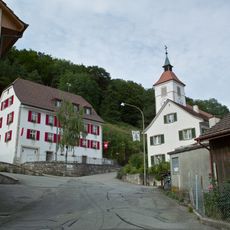
Gilgenberg castle ruin, Medieval castle ruin in Zullwil, Switzerland
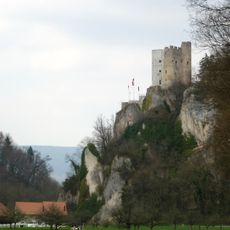
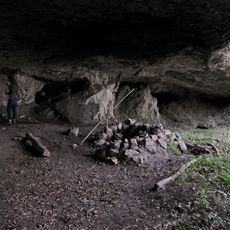
Gilgenberg Castle ruin consists of stone remains perched on a natural rock outcrop at about 710 meters in elevation, surrounded by thick forest. The fragments show the foundation and lower walls of the medieval fortification that once controlled this terrain.
The castle was built around 1300 by the lords of Brislach, also called von Ramstein, over an older structure from about 1200. It served as an administrative centre for their cleared and purchased lands. First documented in 1312 as "Herre ze Gilienberg", it was damaged by the Basel earthquake of 1356. In 1527 Hans Imer sold it with Nunningen, Meltingen and Zullwil to Solothurn for 5900 gulden.
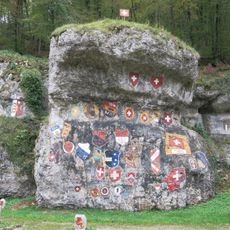
The name Gilgenberg comes from the Ramstein coat of arms, documented from 1265, which shows two crossed lily staffs (Gilgen). The village of Zwingen still bears these crossed lilies in its coat of arms. A Vogt resided at the castle while the Ramsteins lived in Basel or at Zwingen.
The marked hiking trail from Zullwil village reaches the ruins in about ten minutes and is relatively straightforward. In wet weather, some sections may become slippery, so sturdy footwear is recommended.
About 180 metres south of the main ruin, a flat-topped rock ledge marks where a tower once stood. A 1371 deed names it as "the tower in the fields" belonging to Gilgenberg; after 1400 it disappears from records. The artificially levelled rock is still visible today.
The community of curious travelers
AroundUs brings together thousands of curated places, local tips, and hidden gems, enriched daily by 92,721 contributors worldwide.