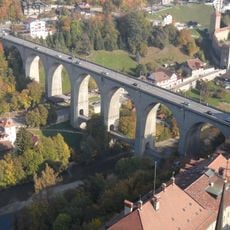
Pont de Zaehringen, Suspension bridge in Fribourg, Switzerland.
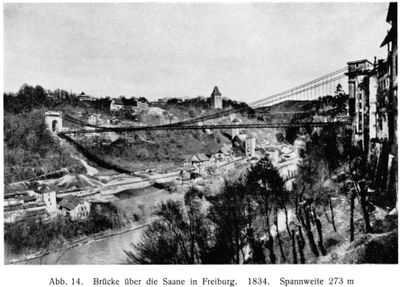
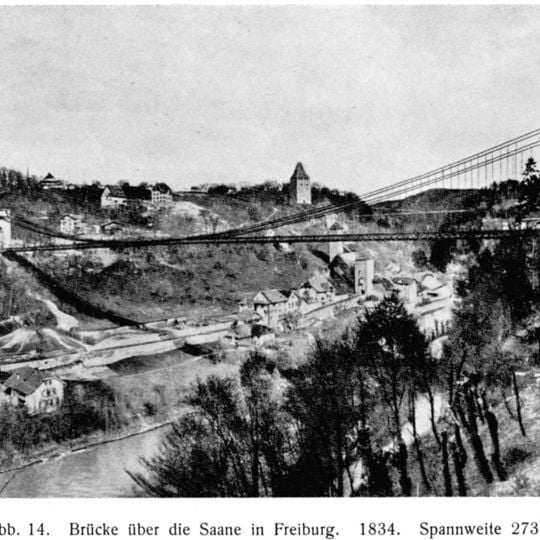
The Grand pont suspendu was a road suspension bridge over the Sarine in Fribourg, Switzerland. Inaugurated in 1834, it was the world's longest suspension bridge at the time and one of the first to use wire cables instead of chains. It was demolished in 1923 to make way for the Zaehringen bridge.
The idea of a new crossing dated to 1826, when a Ticino engineer proposed a stone bridge that lack of funds left unbuilt. French engineer Joseph Chaley, hired for the work, chose a single-span suspension bridge over the public's and shareholders' preference, saving money and time. Work began in March 1832 and cables were fixed on 13 August 1834; inaugurated on 19 October 1834, it was then the world's longest suspension bridge, surpassing the 167-metre Menai Bridge in Wales. It was demolished in 1923 to make way for the Zaehringen bridge.
The name Zaehringen refers to the Zähringen family, who founded Fribourg in 1157; the 1924 replacement bridge took this name, while the 1834 suspension bridge was known as the grand pont suspendu. Its record span was compared to the Menai Bridge in Wales, which held 167 metres.
The bridge was demolished in 1923, so nothing of it remains to cross; the Zaehringen bridge replaced it the following year. To see where it stood, follow the Sarine downstream from the three Basse-ville bridges, the position the 1826 project had chosen.
When it opened on 19 October 1834, the bridge was the longest suspension bridge in the world, surpassing the Menai Bridge in Wales at 167 metres. It was also among the first to use wire cables instead of chains. Engineer Joseph Chaley chose a single span over a pier, against the wishes of the Fribourg public and shareholders.
The community of curious travelers
AroundUs brings together thousands of curated places, local tips, and hidden gems, enriched daily by 94,354 contributors worldwide.