Former collegiate church of St. Verena with church treasure, Catholic parish church in Bad Zurzach, Switzerland
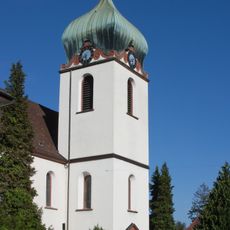
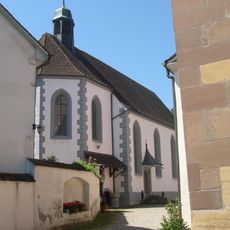
The Verenamünster is a parish church and former collegiate church in Bad Zurzach, built over the grave of Saint Verena in a Roman burial ground. Its early Romanesque nave dates from around 1000, and the Gothic choir tower, consecrated in 1347, was funded by Queen Agnes of Hungary. Inside, a three-aisled hall crypt holds Verena's sarcophagus with a 1613 slab showing a young woman holding a jug and a double comb. The church treasure includes a 14th-century goldsmith's work with an arm relic of Saint Verena.
The first church on the site dates to the 5th century, built over Saint Verena's grave in a Roman burial ground. A Benedictine double monastery, first recorded as Zuriaca in 830, cared for the pilgrims. Between 1010 and 1265 it became the Zurzach collegiate foundation; after the destruction of 1294, the choir and Gothic choir tower were consecrated in 1347, with Queen Agnes of Hungary as donor.
The church is named after Saint Verena, whose veneration drew pilgrims to Zurzach throughout the Middle Ages. Her memorial day on 1 September still brings people seeking help to the church, though on a far smaller scale than in medieval times. The crypt, reached by a tunnel of 1733 and from the south exterior, holds a sarcophagus whose 1613 slab shows a young woman with long hair, a small jug in her right hand and a double comb in her left.
The Verena crypt is reached from the choir through a tunnel built in 1733 and also from the south exterior of the church. Excavations beneath the church in 1975 uncovered a Roman road, graves from the 1st to 4th centuries and burials from around 600 AD. The church treasure with the 14th-century arm reliquary of Saint Verena is kept inside the building.
The Verena crypt beneath the Gothic choir tower is reached by a tunnel built in 1733 and from the south exterior. It is a three-aisled hall crypt in Gothic form, and under a decorated bay lies the sarcophagus whose slab, renewed in 1613, shows a young woman with long hair, a small jug in her right hand and a double comb in her left.
The community of curious travelers
AroundUs brings together thousands of curated places, local tips, and hidden gems, enriched daily by 92,853 contributors worldwide.