Freienbach-Hurden-Rosshorn, Archaeological site on Lake Zurich banks, Switzerland
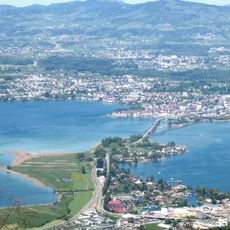
Freienbach-Hurden-Rosshorn is an underwater archaeological site at the tip of the Hurden peninsula in Lake Zurich, in the municipality of Freienbach, Schwyz. Its roughly rectangular core area covers 4.32 hectares, about 400 metres long and 100 metres wide, running northeast to southwest beneath the Seedamm bridge and the northern shore of Hurden. It holds remains of wooden bridges and walkways, not a settlement.
The Rosshorn site records lake crossings rather than a settlement, with wooden walkways and bridges built across the narrowest point of Lake Zurich over more than 3000 years. The oldest finds belong to the Horgen culture; further remains date to the early, middle and late Bronze Age, the Hallstatt period (135 BC), Roman times (165 AD) and the Middle Ages (741 AD). Only a few construction parts of each bridge survive, lying beneath the Seedamm and the adjoining water area.
Unlike the nearby pile-dwelling settlements, Rosshorn holds no house remains: it preserves wooden walkways and bridges that crossed the narrowest point of Lake Zurich for over 3,000 years. The oldest timbers belong to the Horgen culture; later crossings date to the Hallstatt period (135 BC), Roman times (165 AD) and the Middle Ages (741 AD).
The site is visible from the modern Seedamm bridge, which connects Rapperswil to Hurden and crosses the lake. The archaeological zone itself is protected, but public access via the bridge allows visitors to observe the shoreline and understand the landscape directly.
Metal objects discovered underwater are interpreted as ancient ritual offerings that reveal religious beliefs of the time. Remnants of prehistoric bridges also show how people crossed the lake and connected different communities.
The community of curious travelers
AroundUs brings together thousands of curated places, local tips, and hidden gems, enriched daily by 92,777 contributors worldwide.