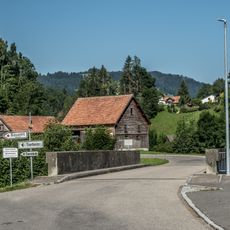
Former Benedictine abbey, Former Benedictine abbey in Neu St. Johann, canton St. Gallen, Switzerland
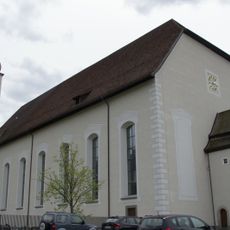
The former Benedictine abbey of Neu St. Johann stands in Sidwald, now part of Nesslau, built in a southern Swiss Baroque style by architect Pietro Andreota and carpenter Kaspar Lederli until 1680. The former abbey church, now the Catholic parish church, has a choir flank tower on its northeast side holding five bells cast in 1870/71 by Grassmayr of Feldkirch. Inside, the west gallery carries a large organ whose case probably involved sculptor Johannes Wirtensohn, and a choir organ by Johann Matthäus Abbrederis (1690–1691) stands at the front left of the choir.
The abbey was a new foundation of the monastery of St. Johann, about 10 km upstream, which had existed since the 12th century and burned down in 1626. The new buildings were erected in Sidwald, later Neu St. Johann, until 1680 under the Misox master builder Pietro Andreota and the Bregenzerwald carpenter Kaspar Lederli. In the religiously mixed Toggenburg it served the Counter-Reformation aims of the prince-abbots of St. Gallen until it was dissolved in 1805.
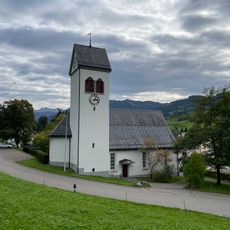
The church is still the Catholic parish church of Neu St. Johann, and the former convent buildings now house the Heilpädagogisches Zentrum Johanneum. In the choir flank tower on the north-east side hang five bells cast in 1870/71 by the Grassmayr foundry in Feldkirch, sounding A-flat, c, e-flat, a-flat and c. A small choir organ built in 1690–1691 by Johann Matthäus Abbrederis for the church in Thal was moved here in 1990.
The former abbey church is now the Catholic parish church of Neu St. Johann and is open to visitors; the remaining convent buildings belong to the Johanneum special-needs centre. The site lies in the village of Neu St. Johann in the municipality of Nesslau, about 10 km down the valley from Alt St. Johann. Look for the five bells cast in 1870/71 by Grassmayr of Feldkirch in the choir flank tower on the north-east side.
The five bells in the choir flank tower on the north-east side were cast in 1870/71 by the Grassmayr foundry in Feldkirch and sound in the notes As°–c′–es′–as′–c″. The large organ on the west gallery goes back to an instrument built presumably in 1779 by Johann Michael Grass of Lommis; Späth Orgelbau reconstructed it in 1988 in the surviving case and enlarged it to 40 stops.
The community of curious travelers
AroundUs brings together thousands of curated places, local tips, and hidden gems, enriched daily by 92,783 contributors worldwide.