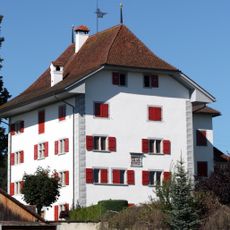
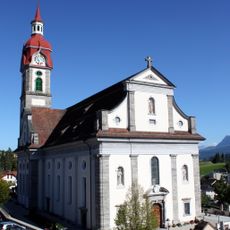
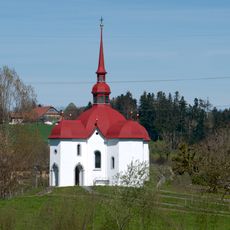
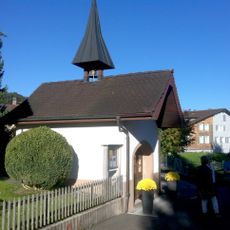
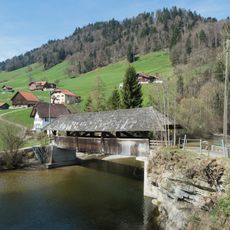
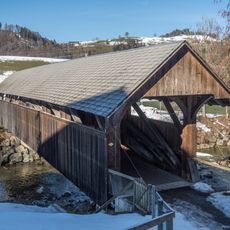
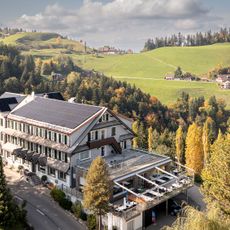
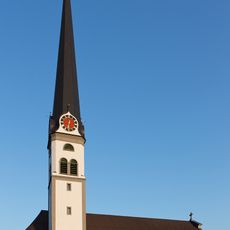
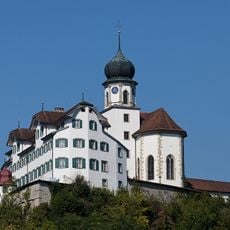
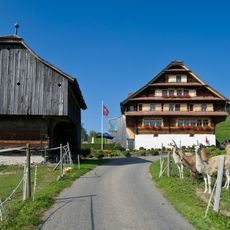
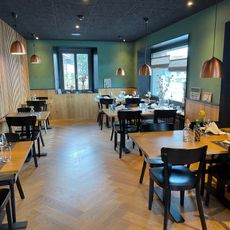
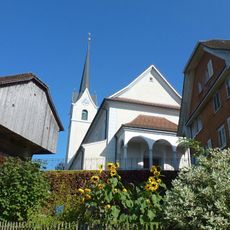
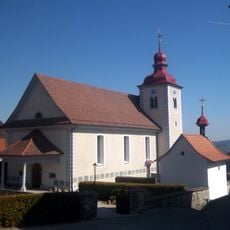
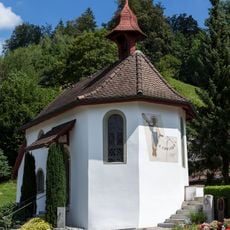
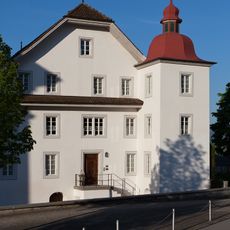
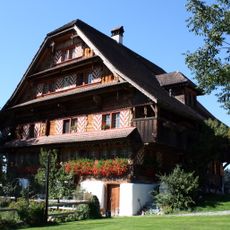
Former Franciscan cloister, Franciscan monastery in Werthenstein, Switzerland.
The former Franciscan cloister in Werthenstein is a stone building complex with closed courtyards typical of medieval monastic architecture. Multiple wings surround the central courtyard, showing how such communities were spatially organized and how monks moved between different areas for work and prayer.
The site began with a chapel consecrated in August 1520, built after reports of an angel apparition and healings. During the Reformation the Pietà from Fribach became the centre of a pilgrimage. The old chapel proved too small, so the Lucerne council decided in 1607 to build a new church, consecrated in 1616. The cloister was handed to the Franciscans on 5 May 1636. In 1826 the nave vault collapsed, and the Lucerne government dissolved the monastery in 1838.
The cloister layout shows how Franciscan monks organized their daily life in this small Swiss community. The enclosed courtyard design reflects the religious values and practical needs that shaped monastic living.
The site is centrally located in Werthenstein and easily accessible on foot, with visible stone walls and clear building outlines. Since it is a historical structure, some areas may have restricted access depending on current use or restoration work.
The cloister stands on a rock above the Kleine Emme, on the Jakobsweg pilgrim route; the valley narrows shortly before Werthenstein, and after a bend the monastery and pilgrimage church appear above a band of rock. Around 1530 some 30,000 pilgrims came each year, and by the 18th century about 80,000, making Werthenstein the second-largest pilgrimage site in Switzerland after Einsiedeln.
The community of curious travelers
AroundUs brings together thousands of curated places, local tips, and hidden gems, enriched daily by 94,546 contributors worldwide.