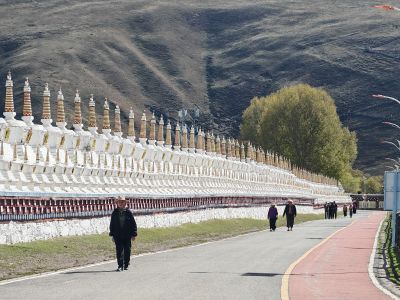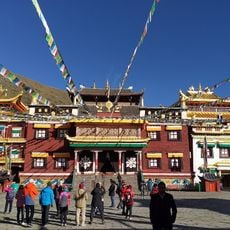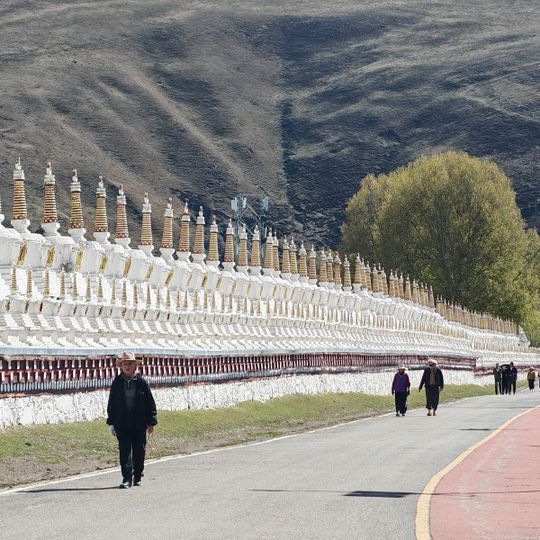
Garthar Gompa, Buddhist temple in Dawu County, China.
Garthar Gompa is a monastery complex spread across mountainous terrain in Sichuan Province, featuring structures built in traditional Tibetan architectural style. The site includes religious sculptures and buildings arranged throughout the landscape that reflect Gelugpa Buddhist traditions.
The Qing court built the temple in 1728, allocating 400,000 taels of silver and stationing 1,800 soldiers, and the Yongzheng Emperor named it Huiyuan si. The Seventh Dalai Lama lived there from 1728 to 1735, and the Eleventh Dalai Lama was born nearby in 1838. Damaged by earthquakes and again during the Cultural Revolution, it was reopened in 1982 and listed as a national heritage site in 2019.
The Tibetan name Garthar Gompa means "Liberation Island"; the Chinese name Huiyuan si was chosen by the Yongzheng Emperor, who wrote its plaque. The monastery holds two living reincarnate lamas, the first being Gokya Tulku, approved in 1992 as the first tulku recognised by the Garzê prefecture government. The Great Prayer Festival is held in the first Tibetan month and the Yachö festival in the sixth.
The monastery lies in Xiande Township, Dawu County, in a valley ringed by mountains said to resemble an eight-petalled lotus. A straight road leads from the entrance area to the gate, where 108 white stupas are set into red walls. The main assembly hall faces east and stands three storeys high, with a grassy courtyard of over 1,000 square metres in front used for religious gatherings.
The monastery was built to the shape of the Yongzheng Emperor's jade seal, according to local tradition. Five stone steles stand in the gate pavilions, including the 1731 imperial stele in Mongol and Chinese; they were thrown down in the Cultural Revolution and used as pigsty flooring before being recovered.
The community of curious travelers
AroundUs brings together thousands of curated places, local tips, and hidden gems, enriched daily by 95,016 contributors worldwide.