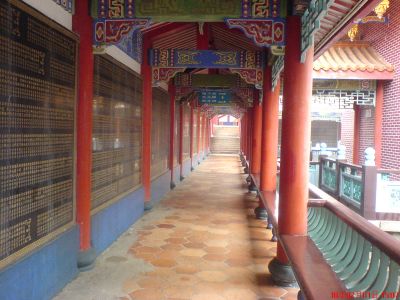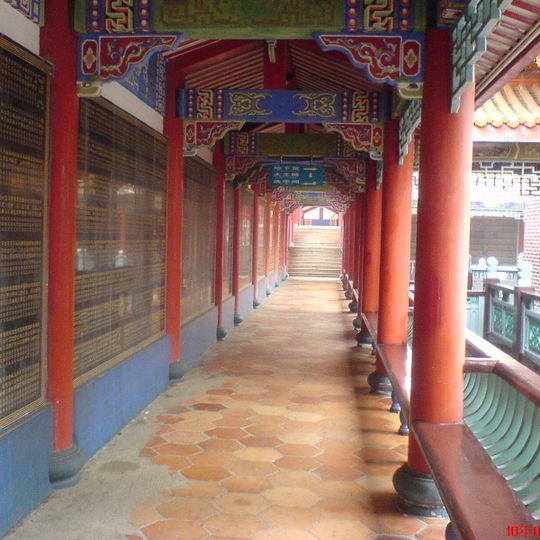
Clay sculptures at Xianying Palace, National-level protected clay sculpture site in Xianqi Village, Zhanggang Town, Changle District, China
The clay sculptures at Xianying Palace comprise over fifty figures unearthed in 1992, of which forty-four are largely intact. They are grouped into five sets, including Mazu, the sea-patrolling god Xunhai Dashen and the Dawa deities, modelled in clay and dated mainly to the Ming and Qing dynasties, with a few pieces possibly from the Yuan.
Xianying Palace was founded in 1138, in the eighth year of the Shaoxing era of the Southern Song, as a temple to Mazu. During the Guangxu reign of the Qing dynasty it was buried by wind-blown sand. Villagers building houses uncovered it again in June 1992, and excavations brought out more than fifty clay figures, forty-four of them largely intact, dated mainly to the Ming and Qing with a few as early as the Yuan. The site was listed as a national key cultural relic in 2006.
Locals call the temple Butterfly Temple (蝴蝶庙), and the clay figures are grouped into five sets: Mazu, the sea-patrolling god Xunhai Dashen, the Dawa, and others. Most date to the Ming and Qing dynasties, a few to the Yuan. The Mazu figures reflect the temple's role as a Mazu shrine in a coastal Fujian village.
The sculptures are inside Xianying Palace in Xianqi Village, Zhanggang Town, Changle District, southeast of Fuzhou. The temple was buried by wind-blown sand in the Guangxu era and uncovered in June 1992 when villagers dug foundations for houses, so the figures now sit in a hall rebuilt after that discovery.
The temple is known locally as the "Butterfly Temple". Buried by wind-blown sand in the Guangxu era, it lay hidden until June 1992, when villagers digging foundations for houses uncovered it again.
The community of curious travelers
AroundUs brings together thousands of curated places, local tips, and hidden gems, enriched daily by 93,863 contributors worldwide.