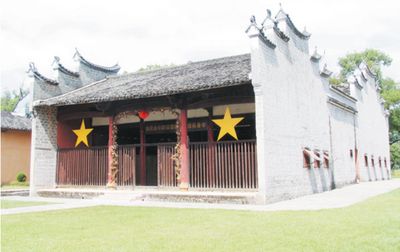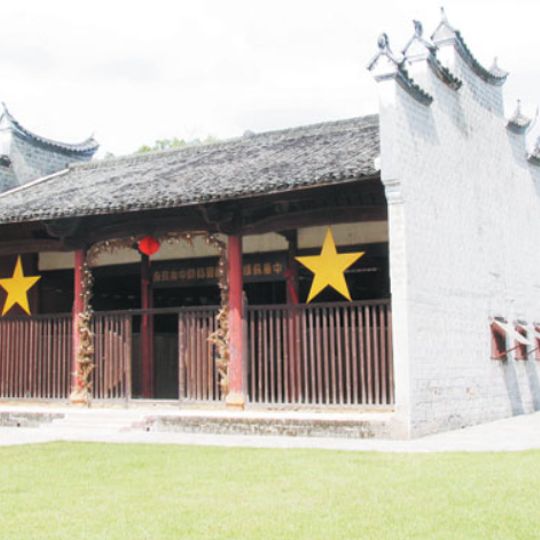
Ruijin Revolutionary Sites, Historical monument complex in Ruijin, China.
Ruijin Revolutionary Sites consist of several historical buildings, memorials, and museums distributed across four districts in the city. These locations document administrative and residential structures from a defining period in modern Chinese history.
Ruijin became the seat of the Chinese Soviet Republic's Provisional Central Government in November 1931, and remained the centre of the Central Revolutionary Base until the Red Army set out on the Long March in July 1934. The sites at Yeping, Shazhouba, Xiaxiao and Wushilong held the Central Workers' and Peasants' Democratic Government, the CCP Politburo and the Central Military Committee. Most buildings were demolished after the Long March; after 1949 they were rebuilt and restored to their original appearance.
The buildings show how leaders and officials lived and worked during that era, with simple furnishings reflecting their focus on political goals. You can see how people shared spaces and collaborated on change.
The 33 protected points are grouped in clusters such as Yeping and Shazhouba, so visiting means moving between separate areas of Ruijin rather than one walled compound. Allow time for transport between clusters and check opening conditions locally before setting out.
Of the 33 protected sites, 15 were listed in 1961 in the first batch of Major Historical and Cultural Sites Protected at the National Level; in 2006 another 18 were added, among them the former Ministry of Grain of the Chinese Soviet Republic. The buildings at Yeping, Shazhouba, Xiaxiao and Wushilong were largely torn down after the Red Army left on the Long March and rebuilt to their original appearance after 1949.
The community of curious travelers
AroundUs brings together thousands of curated places, local tips, and hidden gems, enriched daily by 93,967 contributors worldwide.