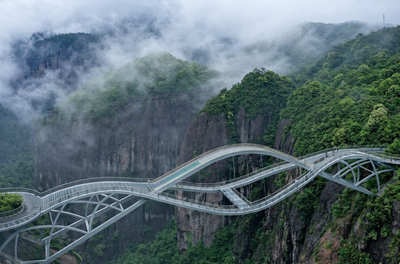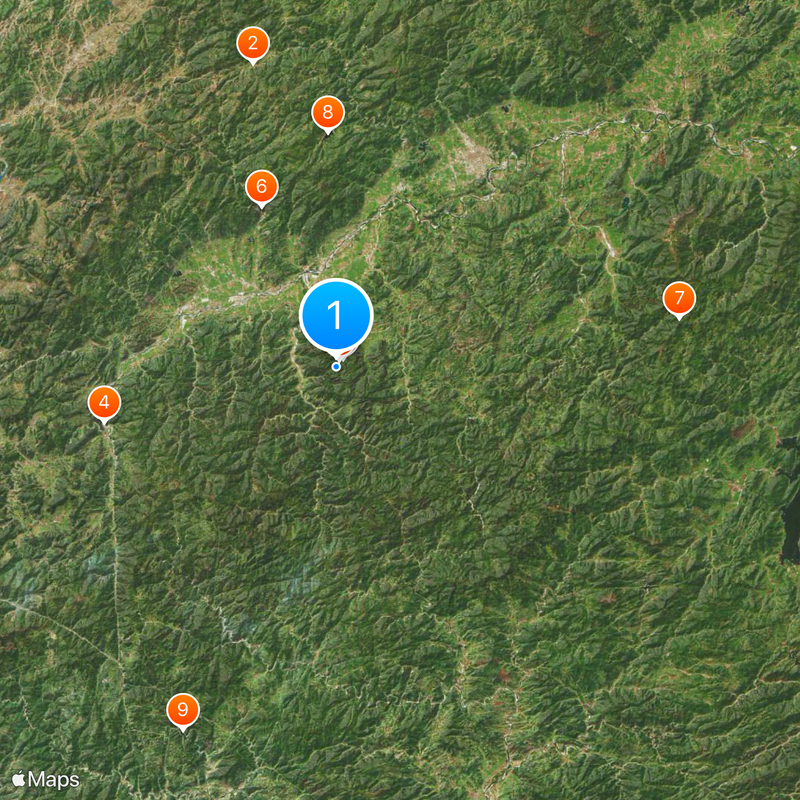
Ruyi Bridge, Steel footbridge in Xianju County, China.
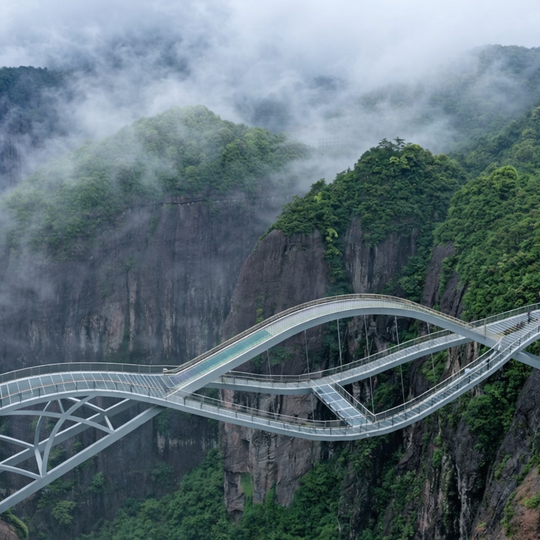
Ruyi Bridge is a pedestrian bridge of three undulating steel decks spanning the Shenxianju Valley in the Shenxianju Scenic Area, Xianju County, Taizhou, Zhejiang. It is about 100 m long and stands 140 m above the ground, with a two-level layout: an upper walkway with a green-tinted glass floor and a lower parallel deck joined by short stair sections. Slender vertical cables drop from the upper arcs to the lower deck, and thin steel arches curve beneath the spans.
Planning for the bridge began in 2017, and it opened in September 2020, drawing 200,000 visitors by November of that year. It was designed by structural steel engineer He Yunchang, who was also involved in the design of the Bird's Nest stadium used at the 2008 Beijing Olympics.
The bridge's three wavy decks are shaped to resemble a jade ruyi, a Chinese symbol of good fortune. Its name, Ruyi Bridge (如意桥), comes from this object. Visitors walk on glass-bottomed sections of the walkways above the Shenxianju Valley.
The walkways allow access to different areas of the scenic park and offer perspectives from different heights. Those comfortable with heights can enjoy the view downward through the glass floors, while others can focus on the surrounding peaks.
In 2020 Canadian astronaut Chris Hadfield posted a drone video of the bridge on Twitter with the caption "I'd want better handrails"; many viewers doubted it was real, and Snopes later confirmed it was not a deepfake. The bridge is one of about 2,000 glass-bottom bridges in China.
The community of curious travelers
AroundUs brings together thousands of curated places, local tips, and hidden gems, enriched daily by 93,481 contributors worldwide.