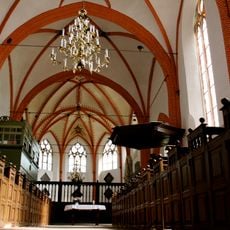
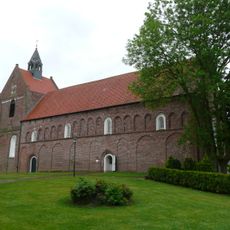
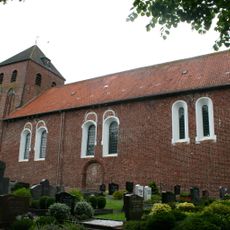
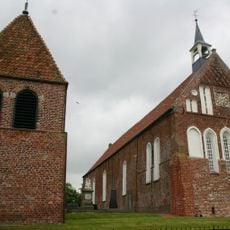
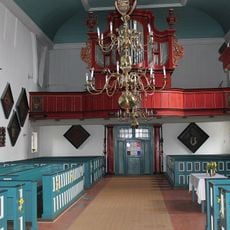
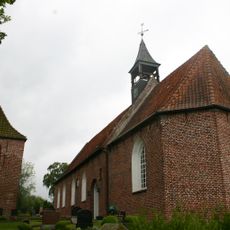
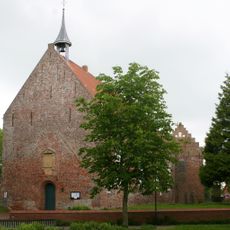
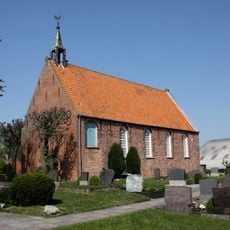
Pipe organ of Uttumer Kirche, Baroque pipe organ in Uttum Church, Krummhörn, Germany.
The organ of Uttum Church is a Renaissance instrument with nine stops on a single manual and no pedal. Its case, painted red and blue since 1716, has folding doors and carved garlands; the facade pipes are lead, replaced in zinc in 1925/26. The organ stands on the east gallery, raised about 20 cm during the 2020–2021 restoration.
Built around 1660 under pastor Cornelius Wybenius Müller, whose name appears on the case, the organ reuses pipes from the 16th or early 17th century, possibly from Sielmönken monastery. In 1716 the wings and carvings were added. Repairs are documented from 1748 to 1881; in 1829 Johann Gottfried Rohlfs moved it to the east gallery. Restored in 1956–57 and 2020–21, it was named Organ of the Year 2021.
The organ was named "Organ of the Year 2021" by the Orgelklang Foundation. Its case bears the name of preacher Cornelius Wybenius Müller (1655–1666), and the rear of the right wing door is marked 1716 in an ornamental medallion. Since the 2020–2021 restoration, the three wedge bellows can again be operated by calcants.
Visitors can experience the organ during regular church services or arrange guided demonstrations of how it works. Check the church's opening times and plan according to the season, as special concerts and performances happen throughout the year.
The organ has nine stops on a single manual and no pedal. In 1917 its six largest facade pipes were mistakenly requisitioned for wartime metal, though they were lead, not tin; they were replaced with zinc pipes in 1925/26. The 1716 date is inscribed on the back of the right wing door.
The community of curious travelers
AroundUs brings together thousands of curated places, local tips, and hidden gems, enriched daily by 94,412 contributors worldwide.