Barrack Wilhelmine, Documentation center and museum in Schwanewede, Germany.
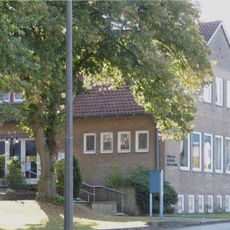
Baracke Wilhelmine is a single-storey, non-basemented barracks of 1939 with masonry, plastered walls and a shallow pitched saddle roof on nailed trusses covered with fibre-cement corrugated sheets. It stands on the grounds of the former Weser-Geest barracks in the Neuenkirchener Heide, at An der Kaserne 122, and has housed the documentation and learning centre since 2007/2008.
Built in 1939 as a solid brick barrack of Marinegemeinschaftslager II, it served Organisation Todt workers and naval construction staff for the Farge naval tank depot. From 1943 it housed the site management for the Valentin submarine bunker, whose construction stopped in March 1945. It then became a naval hospital, part of the Evangelical Hospital Neuenkirchen, and later a Bundeswehr barracks until 2004.
The name "Wilhelmine" dates from the Nazi era: the camp's barracks were given female first names in alphabetical order, and the 23rd barrack received a name beginning with "W", the 23rd letter of the Latin alphabet. The site is run by the Heimatfreunde Neuenkirchen e. V. and includes a separate exhibition section on the "Lebensborn" topic.
The memorial sits on the grounds of the former Weser-Geest barracks, now the Weser-Geest commercial park, at An der Kaserne 122, directly on the access road in the Neuenkirchener Heide. The single-storey brick building has no basement, so the exhibition rooms are on one level. It is run by the Heimatfreunde Neuenkirchen association and has been a listed monument since 2006.
The museum focuses deeply on the topic of Lebensborn, shedding light on a less explored aspect of propaganda and ideology from that period. This specialized focus makes the exhibition particularly valuable for visitors studying this historical era.
The community of curious travelers
AroundUs brings together thousands of curated places, local tips, and hidden gems, enriched daily by 94,242 contributors worldwide.