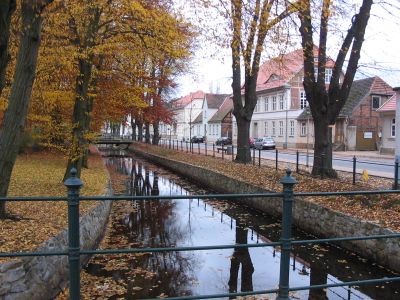
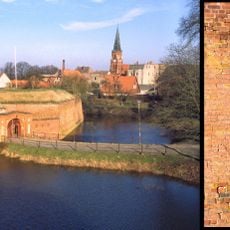
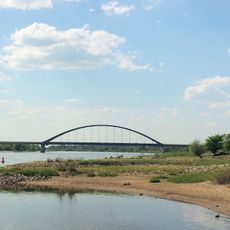
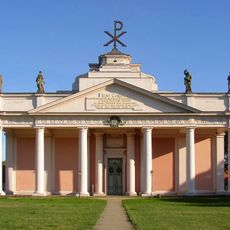
Ludwigsluster Kanal, Canal system in Ludwigslust-Parchim District, Germany
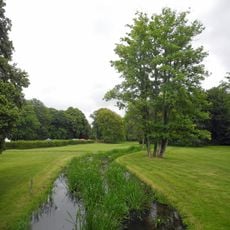
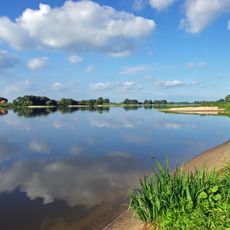
The Ludwigsluster Kanal branches off the Neuer Kanal at Tuckhude and runs about 28 km south into the Ludwigslust palace park, then west and southwest to empty into the Rögnitz at Menkendorf. It drops 15 m between its start at 33 m above sea level and its mouth, and its catchment covers 102 km². West of Ludwigslust it comes within about 30 m of the Rögnitz, where a distribution weir and two bypass channels built in 2009 allow fish to pass.
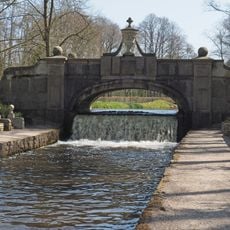
Duke Friedrich II of Mecklenburg-Schwerin ordered the canal built from 1756 to 1760 to feed the fountains and cascades of the new palace park at Ludwigslust. It extended the earlier Drellengraben, since no natural watercourse was available. In 1780 a granite cascade replaced a wooden predecessor, and the canal once also served for floating timber.
The canal feeds the ponds, fountains and cascade of Ludwigslust Palace park, laid out from 1756 at the wish of Duke Frederick II of Mecklenburg-Schwerin. Its granite cascade of 1780 carries three late-Baroque sandstone groups by sculptor Rudolph Kaplunger; the middle one stands for the river gods of the Stör and the Rögnitz.
The canal runs about 28 km from Tuckhude to its mouth on the Rögnitz near Menkendorf, dropping 15 metres. West of Ludwigslust it comes within about 30 metres of the Rögnitz; there a distribution weir and, since 2009, two bypass channels allow fish to pass. The cascade in the palace park was restored from November 2006 to July 2008.
The cascade featuring sandstone figures was built in 1780 and displays three late Baroque works by sculptor Rudolf Kaplunger. The system also includes weirs and bypass channels specifically engineered to allow fish passage.
The community of curious travelers
AroundUs brings together thousands of curated places, local tips, and hidden gems, enriched daily by 93,845 contributors worldwide.