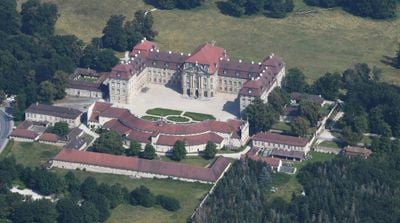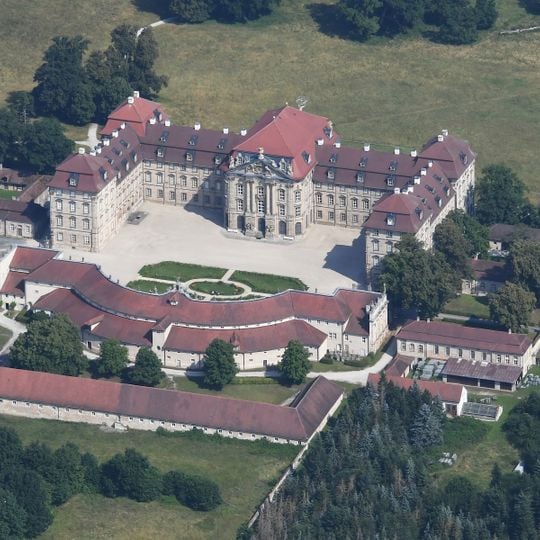
Schloss Weißenstein, Baroque palace in Pommersfelden, Germany.
Schloss Weißenstein is a Baroque palace in Pommersfelden with a grand central staircase flanked by two wings opening onto an inner courtyard. The facade features detailed arches and ornamental elements typical of Baroque design.
Lothar Franz von Schönborn, Prince-Bishop of Bamberg and Archbishop of Mainz, built the palace from 1711 as a private summer residence, funded partly by 100,000 gulden from Emperor Karl VI after the 1711 election. Johann Dientzenhofer designed it, with Johann Lukas von Hildebrandt revising the plans. The shell was finished in 1714, the interior in 1723. Prussian troops damaged it during the Seven Years' War.
The palace holds Germany's largest private collection of Baroque paintings, with over 600 works, including pieces by van Dyck, Rubens, Brueghel, Titian, Artemisia Gentileschi and Dürer. The library assembled by Lothar Franz von Schönborn survives almost complete. Since 1958 young musicians have gathered here each July and August for the Collegium Musicum, performing concerts in the Marmorsaal.
The palace can be visited from early April until the end of October. Since 1958, young musicians have gathered there every July and August for the Collegium Musicum, with concerts in the Marble Hall. Since 2005 the castle park has hosted the annual sales exhibition "Fascination Garden".
The staircase Lothar Franz von Schönborn called "my masterpiece" was the first of its kind in Germany, modelled only on Versailles. Balthasar Neumann later used it as a model for the Würzburg Residence staircase. Its ceiling fresco by Johann Rudolf Byss (1713) shows the four continents then known around the sun chariot of Phoebus Apollo.
The community of curious travelers
AroundUs brings together thousands of curated places, local tips, and hidden gems, enriched daily by 93,214 contributors worldwide.