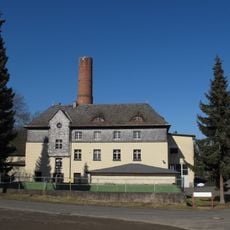
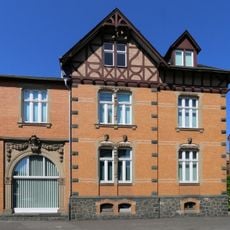
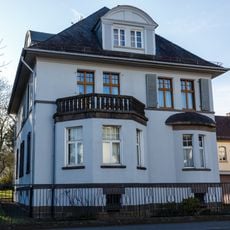
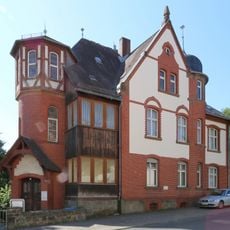
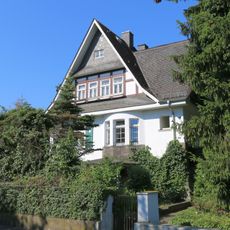
Villa Haas, Manor house in Sinn, Germany.
Villa Haas is a two-storey historicist manor house in Sinn, built of stone with sandstone-framed windows and gables in the German Neo-Renaissance manner. Its roof and gable shapes include dormers, several open balconies, paired windows and a narrow bell tower; 22 chimney flues and seven dormer types are counted among its details. A projecting stair tower with a helmet roof, a mining symbol and a stained-glass window after Johann Heinrich Schilbach stands at the entrance.
The manor house was designed in 1892 by architect Ludwig Hofmann for Rudolf Haas, who operated the nearby Neuhoffnungshütte iron manufacturing facility. The villa reflects the economic prosperity of the industrial era in the region.
The garden's Chinese pavilion and the former pavilion at the Dill cliffs trace back to an idea of the German former colonial officer Retzlaff in Qingdao. The park holds over one hundred plant species, and its territory was described by Johann Daniel Leers in his 1775 book Flora Herbornensis with exact locations.
The villa and park are private property and not open for regular tours; the ensemble on Hansastrasse and Rudolfstrasse is protected as a monument, so the architecture and the landscaped garden with its pond, rondell and tea house are best viewed from the surrounding streets. The site lies at the western edge of the Hörre, at the foot of the Lahn-Dill-Bergland nature park.
The grounds feature a specialized lobster tank with advanced aeration systems, built when the household maintained refined culinary tastes. Alongside this, a Chinese pavilion and ornamental wrought iron gates shape the garden landscape.
The community of curious travelers
AroundUs brings together thousands of curated places, local tips, and hidden gems, enriched daily by 94,022 contributors worldwide.