Eichstätt Cathedral, Gothic cathedral in Eichstätt, Germany.
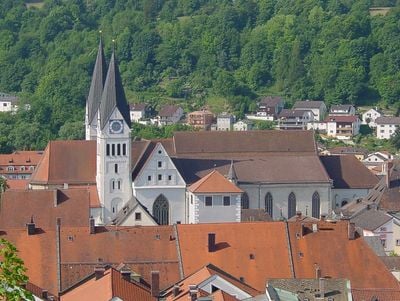
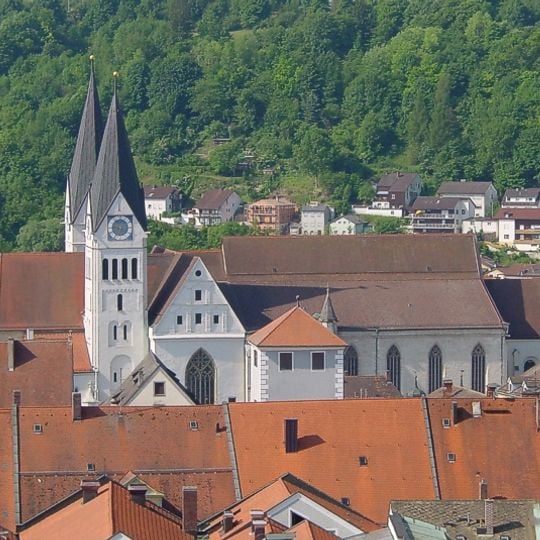
Eichstätt Cathedral is a three-aisled hall church with a white-walled west tower topped by twin dark spires and golden finials, and a round clock face with black numerals. Its long body has a steep brown tiled roof, a gabled section with a large pointed window, and a small octagonal turret. The building is 98 metres long.
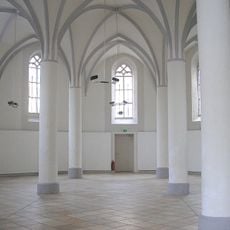
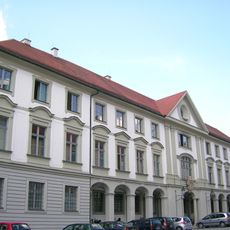
A first stone church was built here by St. Willibald in the 8th century; parts of its masonry survive in the east choir. Bishop Heribert replaced the Carolingian-Ottonian complex from 1022, and Bishop Gundekar II consecrated a new nave and choir in 1060. The present hall church was built from 1256, its north main portal dated 1396, and Gabriel de Gabrieli's baroque west facade was added in 1716–1718.
The cathedral's full dedication names the Virgin Mary, St. Willibald and St. Salvator; Willibald founded the diocese and his relics were translated into the early Gothic west choir from 1256. The diocese celebrated its millennium in 1745, when Bishop Johann Anton II donated the Rococo altar at the start of the Willibaldschor. The attached Cathedral Treasury and Diocesan Museum displays church treasures.
The cathedral is located in the town center and serves as an easy landmark to find. Visitors should allow time to examine the architectural features closely and be prepared for uneven flooring inside.
The cathedral holds 18 bells split between its two towers, one of Germany's largest church bell collections. The oldest, the Frauenglocke, dates from the early 14th century; the Sterbeglocke, or Klag, weighs about 120 kg and rings only at the death of a member of the cathedral community.
The community of curious travelers
AroundUs brings together thousands of curated places, local tips, and hidden gems, enriched daily by 94,155 contributors worldwide.