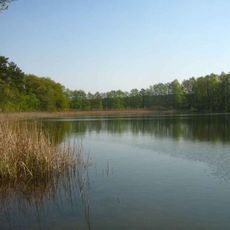
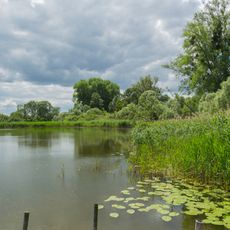
Schweriner See, Lake in Mecklenburg-Vorpommern, Germany
Schweriner See is a large lake in the region divided into two main sections: the Innensee in the south and the Außensee in the north. Together these form a connected water system that shapes the local landscape.
The lake was divided in 1842 by the Paulsdamm, a dam built between its northern and southern basins; a canal beneath a road bridge of the B104 keeps the passage navigable. From 1531, under Duke Albrecht VII, a cutting created the Wallensteingraben link toward Wismar and the Baltic. The Stör remains the natural outflow, draining south to the Elde and Elbe.
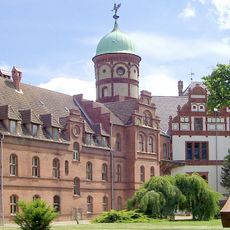
Schwerin Castle sits on an island within the lake and serves as the seat of the state parliament of Mecklenburg-Western Pomerania. The castle's position makes it a defining landmark visible across the water.
The lake is part of the federal Stör-Wasserstraße waterway, and the Paulsdamm, finished in 1842, splits it into the outer and inner lake; the Paulsdammkanal under the B104 road bridge stays navigable. Boats may go no faster than 25 km/h, and 8 km/h near the banks. Yellow buoys mark swimming areas, which boats and canoes must avoid, as they must the reed beds and bird reserves.
Water typically remains in the lake for about ten years before flowing out through the Stör river system. This extended residence time shapes the water quality and ecology of the entire system.
The community of curious travelers
AroundUs brings together thousands of curated places, local tips, and hidden gems, enriched daily by 95,120 contributors worldwide.