Plön Castle, Renaissance castle in Plön, Germany
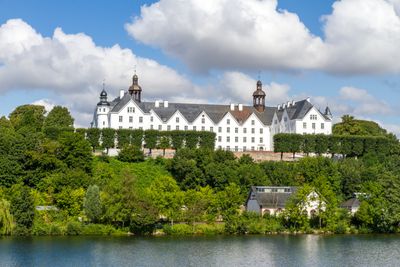
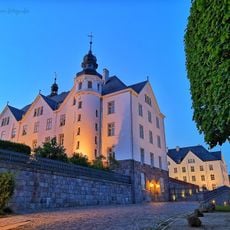
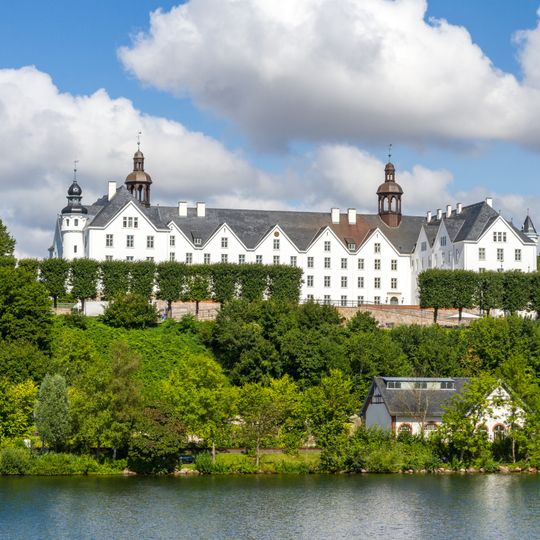
Plön Castle is a long, white-plastered building with a dark grey slate roof, its main wing broken by several projecting gabled sections. Two dark brown domed towers with small lanterns and spires rise from the roofline, and a smaller domed turret sits at the far left corner. Rows of rectangular windows with dark frames run across the facade, and clipped trees line a walled terrace above the wooded slope and the water.
The present castle was built from 1632 on the site of the older Plön hill castle, which Duke Joachim Ernest had demolished. The residence was completed within three years, in the middle of the Thirty Years' War, financed partly by the dowry of his bride Dorothea Augusta of Gottorf. Plön was never as politically weighty as Gottorf, and after Duke Frederick Charles died without a male heir in 1761 the duchy reverted to the Danish crown.
The castle's name comes from the old fortification Plune, first built on Olsborg island in Lake Plön in the 10th century and moved to this hill in 1173. Duke Joachim Ernest founded a library here that his successors grew to 10,000 volumes, and he collected optical instruments and measuring devices, an interest echoed in today's optometry academy.
The castle stands on the Bischofsberg hill above the town and Lake Plön, and since 2002 it has belonged to the Fielmann Akademie, which opened it to visitors only to a limited extent. The interior is therefore not freely accessible; check opening arrangements before climbing up.
Duke Joachim Ernest, who built the castle from 1632, collected optical devices and measuring instruments there, and his library grew to 10,000 volumes. The Fielmann Akademie, which bought the building for 3.6 million euros in 2002, trains opticians and hearing-aid acousticians — a fitting echo of that old interest in optics.
The community of curious travelers
AroundUs brings together thousands of curated places, local tips, and hidden gems, enriched daily by 92,874 contributors worldwide.