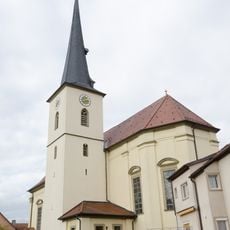
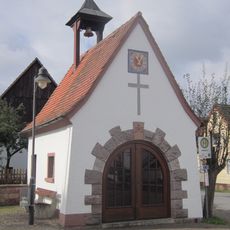
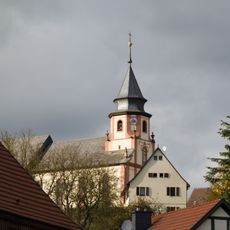
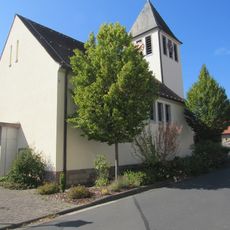
Klosterkirche, Cistercian monastery in Burkardroth, Germany.
The Klosterkirche St. Blasius in Frauenroth is the surviving central nave of a former Cistercian nunnery church, a Romanesque hall church with round-arched blind arcades, lancet windows, a ridge turret and a round apse. The flat-roofed nave leads to a Gothic choir with cross-ribbed vaulting; only the north side still hints at the original three-aisled basilica with side aisles and transept.
The monastery was founded in 1231 and operated as a Cistercian community for over 300 years. Its religious function ended in 1574 when the community was dissolved and the building lost its original purpose.
The site was a Cistercian nunnery, not a monastery of monks; its church is dedicated to Saint Blaise, while the abbey was dedicated to Saint George and All Saints. The Schleiersage tells that Beatrix von Courtenay vowed to found a convent where her wind-blown veil landed. The village of Frauenroth grew only after 1691, when the estate was sold to eight farmers.
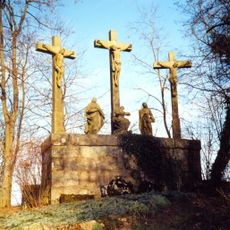
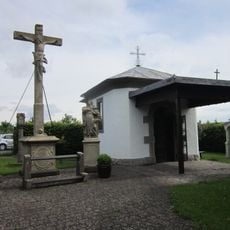
The church stands in the village of Frauenroth, a district of Burkardroth on the eastern edge of the Bavarian Rhön. Only the nave of the former abbey church survives, so the building is smaller than a full monastery complex. A viewpoint with a crucifix above the village gives an overview of the site and its fields.
The high grave of the founders, carved in the third quarter of the 13th century, is considered among the finest early Gothic tomb sculpture in the region and has been linked stylistically to the Naumburg Master and to works in Strasbourg. Art historian Georg Dehio called the figures, despite later reworking of the heads, unrivalled in poetic idealisation of courtly nobility.
The community of curious travelers
AroundUs brings together thousands of curated places, local tips, and hidden gems, enriched daily by 94,641 contributors worldwide.