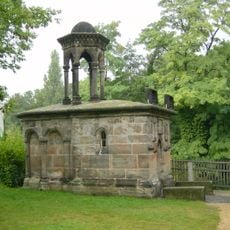
Ölberggarten, Public garden in Görlitz, Germany
The Ölberggarten is a public green space in Görlitz featuring terraced sections and paths that lead through different garden areas. The layout provides several viewpoints from which visitors can look out over the city and its surroundings.
The Ölberggarten was laid out between 1923 and 1928 to plans by garden director Heinrich Diekmann as a strictly formal park. The slope below the 1913 crematorium had previously served as field, meadow, sand pit and rubbish dump. Fruit trees and berry bushes were planted in a rigid grid, and a pergola framed a rose terrace above the main path. Intensive upkeep ceased around 1960.
The hill opposite the burial site was planted with a willow as a symbol of the olive tree, now replaced by a Norway maple; below it lies the Jüngerwiese, the meadow of the sleeping disciples. The Lunitz stream in the valley was renamed Kidronbach to mirror Jerusalem. Since 2004 an audio guide, the "Geh-Hör-Gang" by René Harder and Frieder Zimmermann, accompanies walkers along the two-kilometre Stations of the Cross.
The Ölberggarten can be visited separately only during the warm season. Since 1999 a connecting path links it with the Heilig-Grab-Anlage, and since the 500th anniversary in 2004 an audio guide has accompanied visitors along the roughly two-kilometre Kreuzweg from the crypt of the Peterskirche to the Heilig-Grab-Anlage.
On the hilltop above the garden stands the municipal crematorium built in 1913, which has dominated the northeastern skyline ever since. The slope below it served as farmland, meadow, sand pit and rubbish dump until the 1920s, before being laid out as the garden.
The community of curious travelers
AroundUs brings together thousands of curated places, local tips, and hidden gems, enriched daily by 93,986 contributors worldwide.