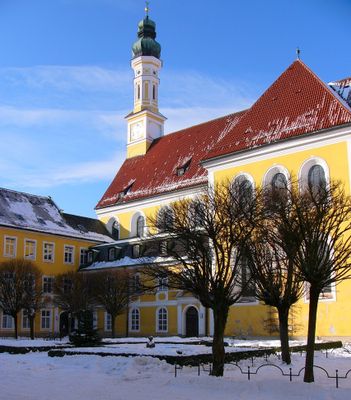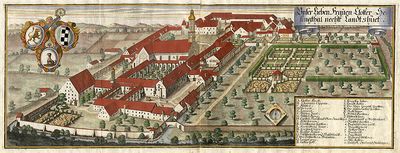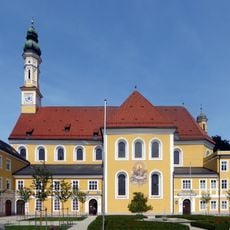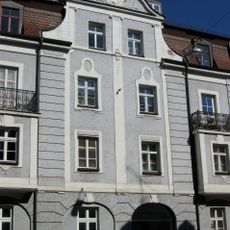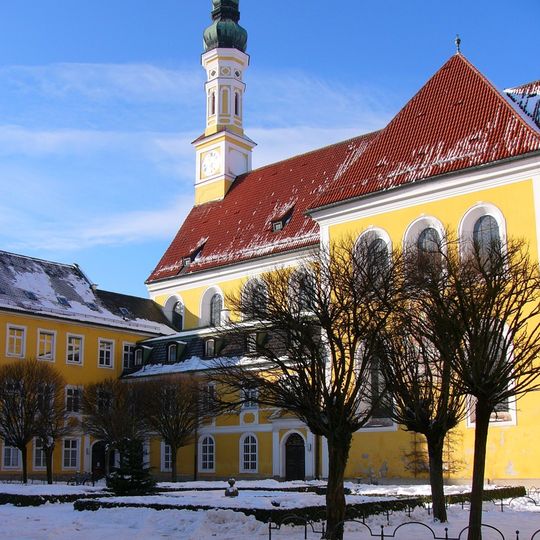
Seligenthal Abbey, Cistercian nunnery in Landshut, Germany.
Seligenthal is a Cistercian nunnery founded in 1232 in Landshut. Its abbey church, consecrated in 1259 and rebuilt in early Rococo style in 1732–34 by Johann Baptist Gunetzrhainer, has a central plan with stucco and ceiling frescoes by Johann Baptist Zimmermann. The complex includes a church tower built in 1698 and convent buildings around courtyards.
Ludmilla, widow of Duke Louis I of Bavaria, founded the monastery in 1232; she lived there and was buried in the Afra Chapel in 1240. The abbey church, consecrated in 1259, became the burial place of the Wittelsbach dukes. In 1732–34 Johann Baptist Gunetzrhainer rebuilt it as a central building in early Rococo style, with stucco and ceiling frescoes by Johann Baptist Zimmermann. The monastery was dissolved in 1803 and re-established in 1835.
The name Seligenthal was first recorded in 1245 or 1246, when the house was incorporated into the Cistercian order. Two early Gothic wooden figures in the abbey church, one bearing an early form of the Bavarian lozenge coat of arms, recall founder Ludmilla and her husband Louis I. The nuns ran a girls' school from 1782 until its closure in 1820; today the complex again holds a kindergarten, a Grundschule, a Wirtschaftsschule, a Gymnasium and a Fachakademie für Sozialpädagogik.
The monastery houses an educational campus today with kindergarten and multiple school levels, making it active as a learning community. Visitors should note that the grounds remain primarily in use as an educational institution.
Two early Gothic wooden figures in the abbey church, bearing an early form of the Bavarian lozenge coat of arms, commemorate founder Ludmilla and Duke Ludwig I. Ludmilla was buried in the Romanesque Afra Chapel in 1240, and her remains were later moved into the abbey church.
The community of curious travelers
AroundUs brings together thousands of curated places, local tips, and hidden gems, enriched daily by 94,351 contributors worldwide.