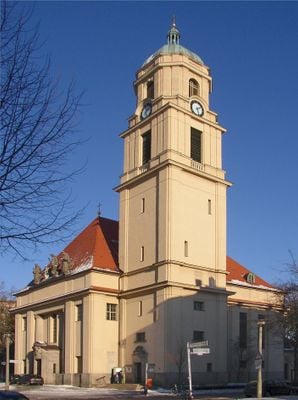
Hoffnungskirche, Art Nouveau church in Pankow, Germany.
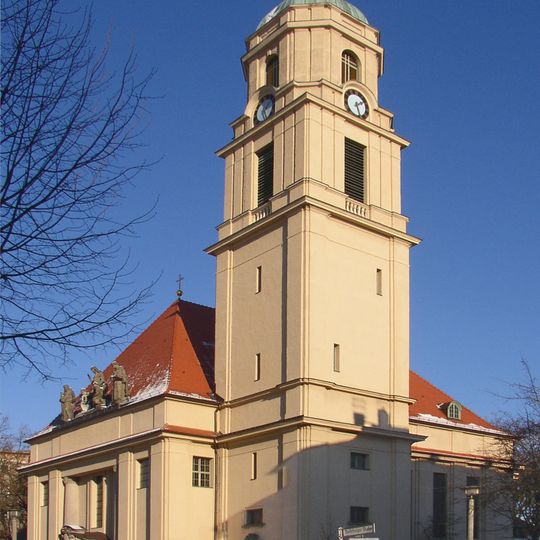
Hoffnungskirche is a church building in Art Nouveau style featuring massive pilasters on its facade and a pagoda-like roof crowned with a tall gabled structure. The structure rests on wooden piles with plastered masonry and includes sturdy balconies supported by four columns across three interior sides.
The Hoffnungskirche was built by an artists' group led by architect Walter Koeppen and consecrated on 12 September 1913. Its design followed the 1890 Wiesbaden Programme, which rejected historicist styles in favour of a central plan for closer congregational involvement. The church was restored in 1985–1987, when the original colour scheme was partly recreated.
The Jugendstil interior uses colour symbolically: the main entrance is violet, contrasting with moonlight tones of pink, lilac, stucco and light grey, black verticals with grisaille paintings, and a royal-blue altar wall with a starry sky. The dominant Art Nouveau motif of woman appears sacrally transformed in many of the 36 angels, most painted, some carved in stone.
The church stands at the corner of Elsa-Brändström-Straße and Trelleborger Straße in Pankow, with the tower on the southwest side marking the street front. The main west portal is reached from Elsa-Brändström-Straße; the entrance there is painted violet. Look for the sandstone figures of two angels flanking Christ above the portal before entering.
On 9 April 1988 Die Toten Hosen played in the churchyard, not inside the building. The West Berlin producer Mark Reeder arranged the open-air show; local punk band Die Vision opened, and its singer Uwe Niels von Geyer was later accused of informing the Stasi. Around 80 spectators saw the start, roughly 200 by the end.
The community of curious travelers
AroundUs brings together thousands of curated places, local tips, and hidden gems, enriched daily by 94,523 contributors worldwide.