St. Stephan's Cathedral, Passau, Baroque cathedral in Passau, Germany
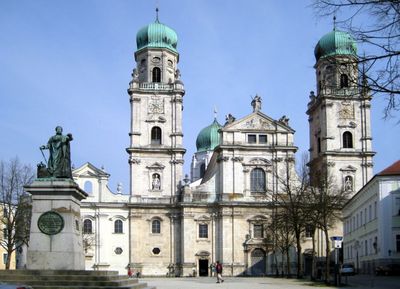
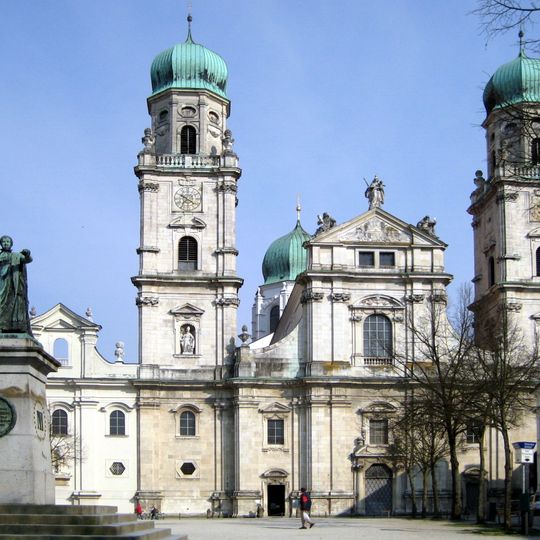
St. Stephen's Cathedral is a baroque church about 100 metres long, built from 1668 to 1693 to Carlo Lurago's plan after the fire of 1662; only the late Gothic east end survived. Its west front has two towers whose octagonal upper storeys and neo-baroque copper domes were added in 1896, and a green-domed crossing tower rises behind the curved pediment. The interior, decorated by Giovanni Battista Carlone with frescoes by Carpoforo Tencalla, is the largest baroque church interior north of the Alps.
A fire in 1662 destroyed the previous cathedral, leaving only the late Gothic east end. Prince-Bishop Wenzeslaus Graf Thun commissioned the rebuild from 1668 to 1693, with plans by Carlo Lurago, interior decoration by Giovanni Battista Carlone and frescoes by Carpoforo Tencalla. The octagonal upper storeys and neo-baroque domes of the west towers were added in 1896.
The cathedral is dedicated to Saint Stephen, whose feast the diocese long marked on 5 August, the date of the 985 consecration of the choir; since recent times the dedication is celebrated on 3 August. The eight bells are rung from the north and south towers, and the largest, the 7,550 kg Pummerin cast in 1952, hangs in the south tower beside the 1733 Stürmerin.
The cathedral stands on the highest point of the old town between the Inn and the Danube, 13 m above the river. The baroque west facade faces the Domplatz; the late Gothic east choir is reached from the same square. The main entrance is the dark door beneath the curved pediment, and the organ gallery is inside the nave.
The cathedral houses one of the world's largest church organs with more than 17,000 pipes and hundreds of registers. This organ is operated from multiple consoles and is a technical achievement that attracts music lovers from around the world.
The community of curious travelers
AroundUs brings together thousands of curated places, local tips, and hidden gems, enriched daily by 92,878 contributors worldwide.