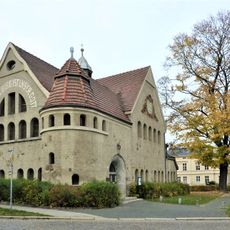
St. Jakobus, Catholic cathedral in Görlitz, Germany
St. Jakobus is a neo-Gothic hall church in brick, built 1898–1900 to plans by Joseph Ebers, with a 68-metre tower on a hill. Its three naves are covered by vaults; inside survive fragments of the original wall paintings and ornamental glazed tiles. After World War II artillery damage it was rebuilt with a simplified spire and without the dormers.
Built 1898–1900 to plans by Joseph Ebers and consecrated on 6 October 1900, it was meant as a second church for the Holy Cross parish; Bishop Adolf Bertram made it a parish church in 1918. In 1947 Vicar Capitular Ferdinand Piontek moved the Breslau chapter's exile seat here, and in 1972 it became procathedral of the Apostolic Administration of Görlitz. The diocese was founded in 1994, raising St. Jakobus to cathedral.
The cathedral is dedicated to the Apostle James the Elder and to John the Baptist, the patron saints of the Görlitz cathedral chapter. That chapter is a college of six diocesan priests, a provost and five canons, and it has its seat at St. Jakobus. Since 2012 the building has also belonged to the parish of St. Wenzel.
The cathedral stands on a hill above the Neisse, its 68-metre tower visible from afar. The interior was closed from February 2020 to 28 November 2021 for renovation; the vault now carries a 2.6-metre QR code by Helge Warme, mirrored in two metal plates set into the floor. Look up and down to compare them.
The organ, built by Hermann Eule Orgelbau of Bautzen in 1988–1989 as opus 545, has three manuals and 47 registers with mechanical key action and electric stop action; the builder overhauled it in 2008. During the 2020–2021 interior renovation, artist Helge Warme painted an unreadable 2.6-metre QR code on the vault, and two matching codes set into metal floor plates encode Mark 10:21, "Come, follow me."
The community of curious travelers
AroundUs brings together thousands of curated places, local tips, and hidden gems, enriched daily by 94,466 contributors worldwide.