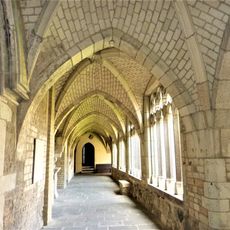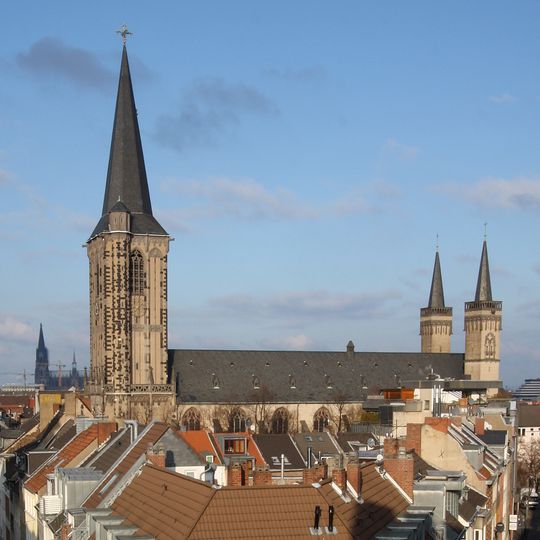
Basilica of St. Severin, Romanesque basilica in Altstadt-Süd, Germany
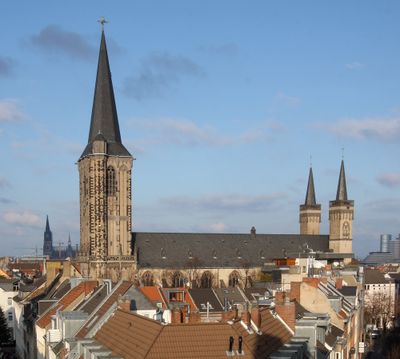
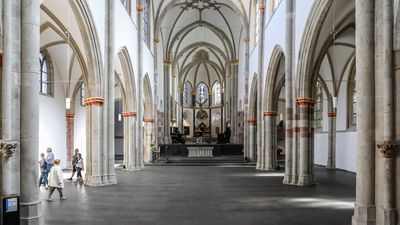
The Basilica of St. Severin is a Romanesque pillar basilica with a long slate roof, a tall west tower with a pyramidal spire, and two shorter clock towers on the east side. Below the roofline runs a row of pointed arched windows. The nave is covered by a late Gothic net vault from around 1500, and the hall crypt consecrated in 1043 survives in its western part.
The site began in late antiquity as a memorial chapel built over a Roman cemetery and was later transformed into a medieval church. The oldest sections of the present structure date to the 10th century, when it took on its current form.
The church is also known in Kölsch as Zint Frings. Each year an evening procession, the Severinusfest, carries the saint's reliquary shrine through the Südstadt. Since 2005, fourth- or fifth-century Central Asian silk cloths with colourful animal motifs and the Severinus disc have been displayed in the south crypt.
The church is easily accessible on foot in the Altstadt-Süd district with central location making it straightforward to reach. Interior access is generally available, but it is wise to verify current visiting times in advance, as these can vary due to services and events.
The octagonal labyrinth from the original nave floor, laid around 1500, survives and is now held by the Diocesan Museum. The relics' oak casket, sealed under Archbishop Hermann III von Hochstaden, was opened in 1999 after rain damage; the silk fabrics wrapped around the bones date to about 400.
The community of curious travelers
AroundUs brings together thousands of curated places, local tips, and hidden gems, enriched daily by 94,360 contributors worldwide.