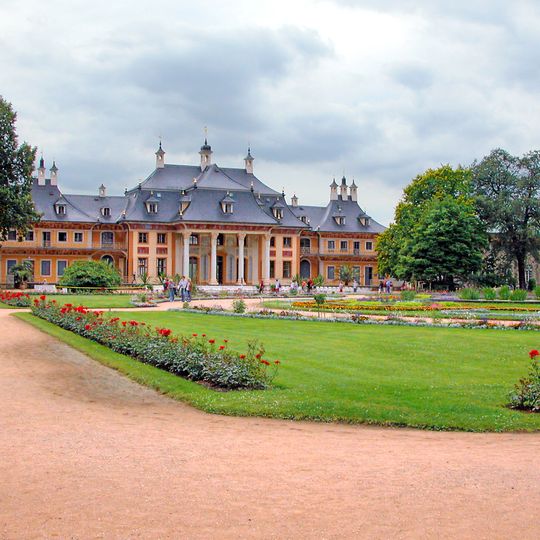
Pillnitz Castle, Baroque castle complex in Dresden, Germany.
Pillnitz Castle consists of three main buildings: the Riverside Palace (Wasserpalais) on the Elbe, the Hillside Palace (Bergpalais) opposite, and the Neoclassical New Palace linking them on the east. The two Baroque palaces, built 1720–1724 to designs by Matthäus Daniel Pöppelmann, have pale yellow walls, dark steep roofs and Chinoiserie details. The New Palace, designed by Christian Friedrich Schuricht and completed in 1826, has a central domed hall.
The site was transformed from a fortress into a grand summer retreat in the early 1700s under Augustus II the Strong, with major architectural work shaping its current appearance. This transformation made it one of the region's most important baroque complexes and influenced the development of Dresden's landscape.
The name Pillnitz comes from the old village on the Elbe where the palace stands. Since 1765 the Wettin court used the complex as a summer residence, and today the New Palace holds the Schlossmuseum, whose royal kitchen displays original copper pots and reconstructed cooking machines used by about 27 staff. The Catholic chapel in the east wing has frescos by court painter Carl Christian Vogel von Vogelstein showing scenes from the life of the Virgin Mary.
The grounds are open daily and offer plenty of space to explore on foot, with wide pathways leading through different garden areas. Comfortable shoes are recommended since the entire site is quite large and there are multiple buildings to visit at your own pace.
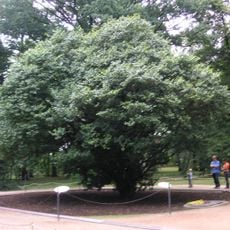
The park's camellia, a Camellia japonica planted in 1801, is over 230 years old and reaches 8.9 metres. From February to April it can produce up to 35,000 blooms. Each winter it is protected by a glass house on rails.
The community of curious travelers
AroundUs brings together thousands of curated places, local tips, and hidden gems, enriched daily by 93,783 contributors worldwide.