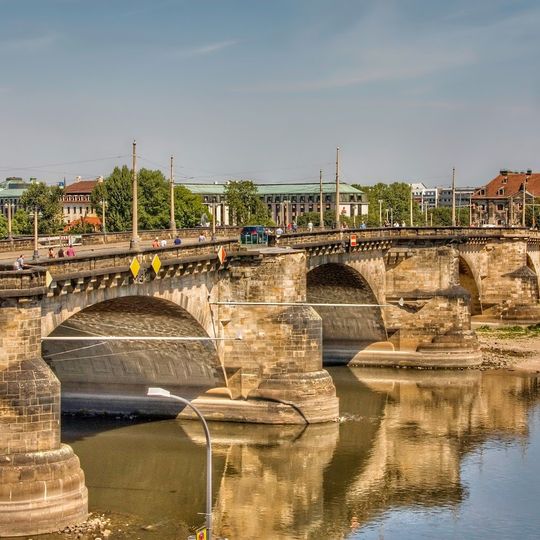
Augustus Bridge, Arch bridge in Dresden, Germany
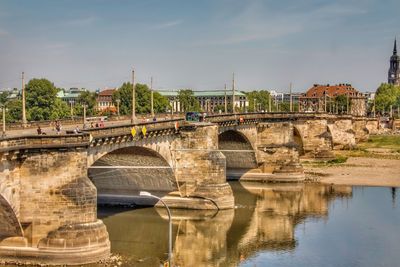
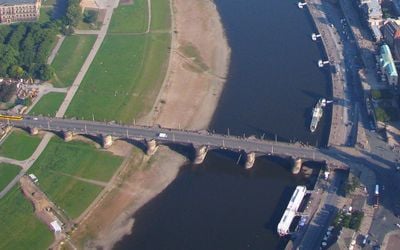
The Augustus Bridge is a sandstone arch bridge over the Elbe, joining the Innere Neustadt on the right bank with Dresden's historic centre on the left. Its flat deck rests on nine arches carried by eight piers and two abutments, with a plain railing and thin poles along the side. It was designed by Wilhelm Kreis and Theodor Klette and built between 1907 and 1910.
A stone bridge with 24 arches and 25 piers stood here from the 13th century, one of medieval Europe's largest bridge works. Under Augustus the Strong, Matthäus Daniel Pöppelmann rebuilt it in sandstone between 1727 and 1731 with 12 arches. The present sandstone bridge with nine arches, designed by Wilhelm Kreis and Theodor Klette, was built between 1907 and 1910.
The bridge owes its name to Augustus II the Strong, under whom Matthäus Daniel Pöppelmann and Johann Gottfried Fehre rebuilt the crossing in 1727–1731. A 4.5-metre crucifix cast by Andreas Herold in 1670 once stood on the fifth pier until that pier collapsed in the Elbe flood of 31 March 1845. Since 2022 the deck has been reserved for public transport, pedestrians and cyclists.
Since 2022 the bridge has been closed to private motor traffic and reserved for public transport, pedestrians and cyclists, so crossing on foot is direct. The deck runs between the Innere Neustadt on the right bank and the historic centre on the left bank, with the Elbe visible on both sides.
The first stone bridge on this site had 25 piers and 24 arches and was about 561 metres long, among the longest stone bridges of its era in Europe. Two drawbridges and a wooden middle opening could be burned in an emergency to defend Dresden. Remains of this structure survive underground at both ends.
The community of curious travelers
AroundUs brings together thousands of curated places, local tips, and hidden gems, enriched daily by 92,946 contributors worldwide.