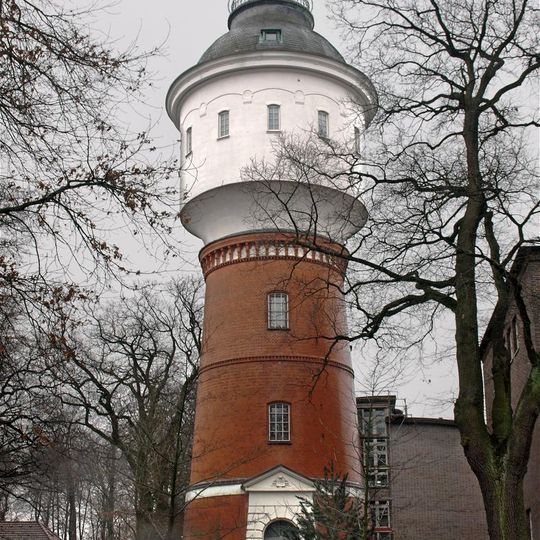
Wasserturm Hamburg-Bergedorf, Water tower in Bergedorf, Germany
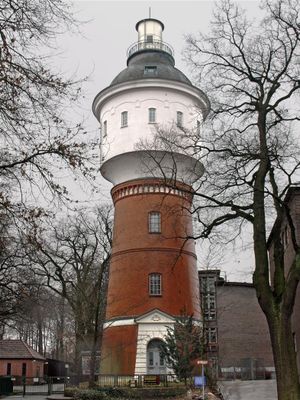
Wasserturm Hamburg-Bergedorf is a 31-metre brick tower built in 1903 to designs by Bergedorf city architect Carl Friedrich Dusi, its shaft tapering upward to a white concrete head. A rusticated neoclassical portal bearing the Bergedorf coat of arms marks the ground floor, and a slate-covered domed roof ends in a gallery with a wrought-iron railing. Inside, a staircase runs along the shaft wall to the original 230 m³ Intze tank, whose central cylinder holds a spiral stair.
The tower was built in 1903 under city architect Carl Friedrich Dusi and served as the main water supply facility for Bergedorf until operations ended in 1973. The building later gained protected status as a cultural monument and underwent major renovations.
The tower marks the edge of a villa neighborhood and reflects how industry shaped Hamburg's early 20th century development. Walking around it, you notice how such buildings once connected industrial progress with residential areas in the city.
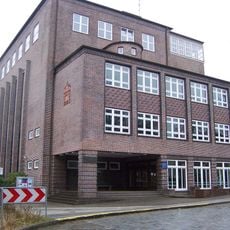
The tower is privately owned and was converted into a dwelling, so the interior and the observation gallery are not open to visitors. The structure stands on the Pfingstberg, largely hidden behind the buildings of the Luisen-Gymnasium; only its top is visible from the surrounding residential area.
The tower was meant to double as an observation point, but residents barely used it, and the gallery was closed to the public before World War I. The 230 m³ Intze type 1 tank survives inside; doors were cut into its central cylinder to create two semicircular rooms.
The community of curious travelers
AroundUs brings together thousands of curated places, local tips, and hidden gems, enriched daily by 92,916 contributors worldwide.