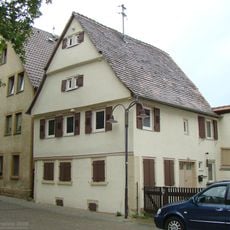
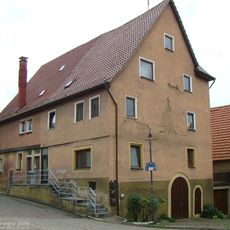
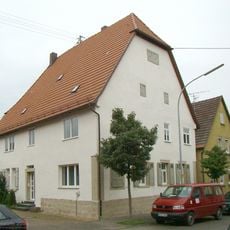
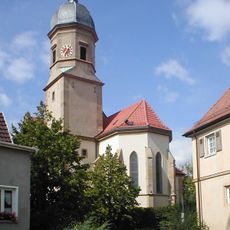
Schloss Klingenberg, Medieval château in Heilbronn, Germany.
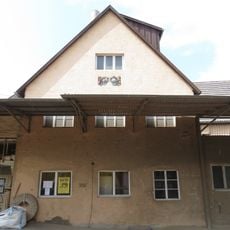
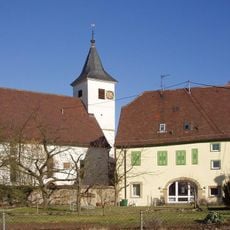
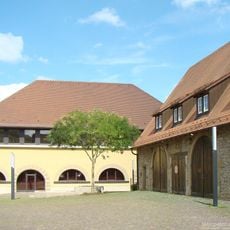
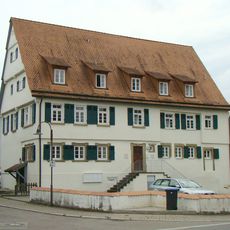
Schloss Klingenberg stands on a hill spur above the Neckar in the Heilbronn district of Klingenberg, on the remains of a castle wall with fragments of a Staufer bergfried. In its east corner a basement level of the old castle survives, with walls up to one metre thick and a vault. The single-storey Schlössle facing the courtyard was built in the mid-17th century, and the servants' house, with corner stones dated 1526, was rebuilt in Baroque form in the 18th century.
The Lords of Neipperg acquired the property in the early 15th century and established it as their main residence. They abandoned it only when Schloss Schwaigern was built in 1702, shifting the family seat to that new location.
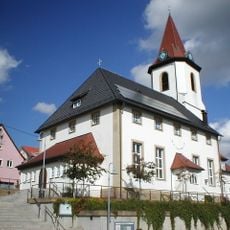
The name Klingenberg comes from the knightly family first recorded in 1293 with Reinbot von Klingenberg, after whom the Reinbotstraße in the village is named. The castle was their seat, and from 1554 Philipp von Neipperg made it the family's main residence. A chapel was installed in 1950 between the servants' house and the ring wall, with stained glass by Josef de Ponte.
The castle stands on a hill spur southwest of Klingenberg above the Neckar, reached via the Reinbotstraße named after Reinbot von Klingenberg. The complex is used for residential and commercial purposes, so the buildings are not open to visitors; the exterior walls, the one-storey Schlössle facing the courtyard and the 1950 chapel between servants' house and ring wall can be viewed from outside.
During World War II, Slovenian forced laborers were housed at the castle and worked in surrounding fields to support the German war effort. This lesser-known aspect of its past reflects the complex history the place endured.
The community of curious travelers
AroundUs brings together thousands of curated places, local tips, and hidden gems, enriched daily by 94,361 contributors worldwide.