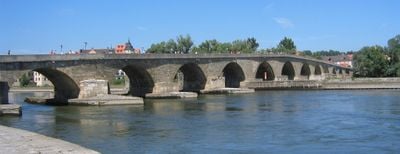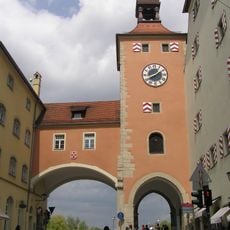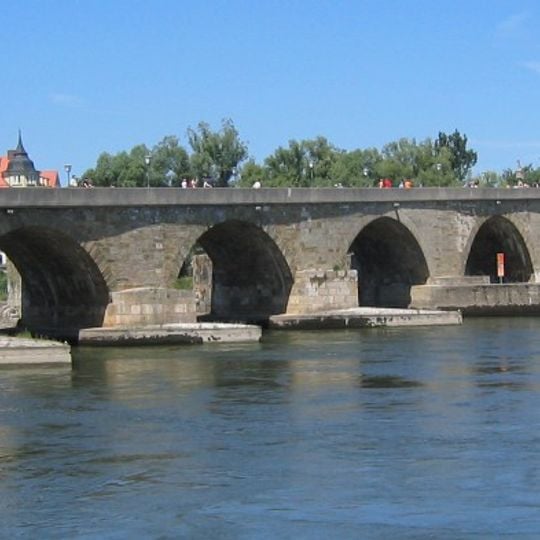
Stone Bridge, Stone bridge in Regensburg, Germany.
The Stone Bridge is a natural-stone arch bridge of 16 segmental arches, of which 14 are visible today; the first is buried under the southern approach and the last is covered by the Stadtamhof bridge bazaar. It runs slightly curved to the east, rises 5.50 m toward the middle, and its piers stand on oak-log foundations inside cofferdams, ringed by pillar-shaped abutments. The southern end sits half a metre lower than the northern one.
Construction began in the mid-1100s and was completed within about eleven years, making it the first permanent Danube crossing in Regensburg. It remained the only bridge crossing until modern bridges opened in the 1930s, fundamentally shaping the city's development.
The bridge's landmark is the Brückenmännchen, a small figure on the bridge that has long been a well-known symbol of Regensburg. From the early 13th century, sculptures on the piers and parapets served as legal signs, reminders of people and events, or protection against disaster. Many damaged originals were removed during the 2010 renovation and stored in the city museum.
The bridge is open only to pedestrians and cyclists, as vehicle traffic is no longer permitted on the structure. Ongoing restoration work may occasionally affect access to certain sections, so checking conditions beforehand is advisable.
The piers leave gaps as narrow as four metres, producing the whirlpools known as the Regensburg Danube Strudel. Upstream barges too weak to pass were towed through until 1916, when an electric system drew ships under the arches; it was removed in 1964. Napoleon noted the obstacle in 1809, and demolition of the bridge was proposed as early as 1904.
The community of curious travelers
AroundUs brings together thousands of curated places, local tips, and hidden gems, enriched daily by 94,043 contributors worldwide.