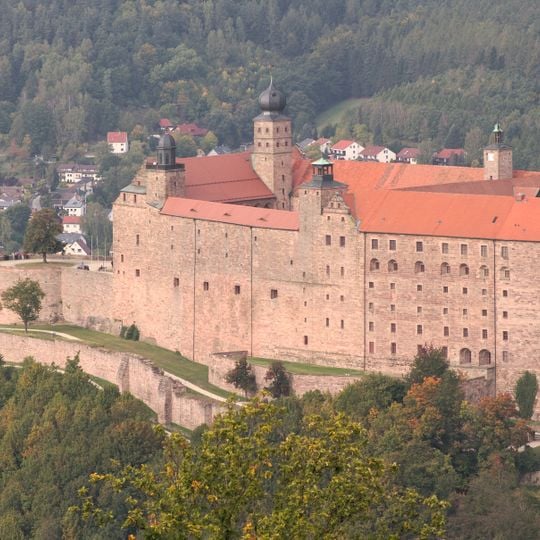
Plassenburg, Renaissance fortress on hilltop in Kulmbach, Germany
Plassenburg is a former state fortress and residence castle on a hill above Kulmbach, rebuilt from 1557 to plans by Caspar Vischer as a Renaissance fortified palace. Its long main block of light reddish-brown stone has three rows of small windows under a steep red-tiled roof, with two round domed towers on the left and two square spired towers on the right.
The fortress served as the residence of the Hohenzollern family from 1340 until 1604, and they ruled their Franconian territories from this base. After that period, it passed to different rulers who transformed and expanded it over time.
The name Plassenburg comes from the Plassenberg family, ministeriales of the Andechs counts, who took their seat here; a Gundeloh von Blassenberg appears in 1149 as ancestor of the Franconian Guttenbergs. Today the castle holds the Landschaftsmuseum Obermain, the German Tin Figure Museum, the Friedrich the Great Army Museum and the Museum Hohenzollern in Franconia.
The path to the fortress leads steeply uphill and requires good walking shoes, though you can also drive and park at the top. The interior spaces spread across multiple levels, so wear comfortable shoes and allow plenty of time to explore.
The German Tin Figure Museum moved into the Plassenburg in 1959; its dioramas are built from flat, semi-relief tin figures, a format developed in Germany around 1800. The collection also covers the armoury of Margrave Frederick and the Hohenzollern museum in Franconia, all under one roof.
The community of curious travelers
AroundUs brings together thousands of curated places, local tips, and hidden gems, enriched daily by 94,124 contributors worldwide.


