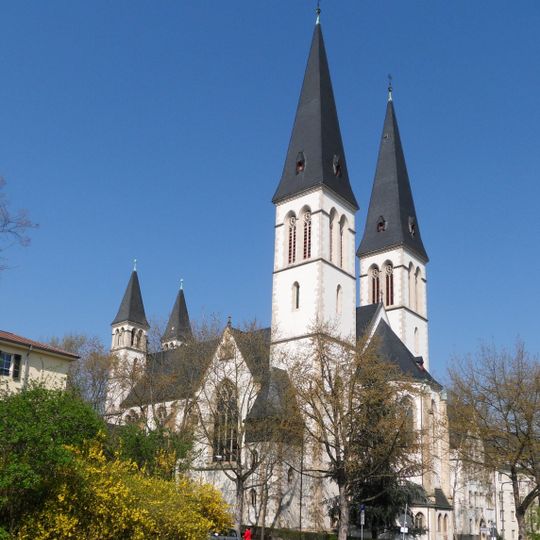
Dreifaltigkeitskirche, Romanesque Revival church in Wiesbaden, Germany.
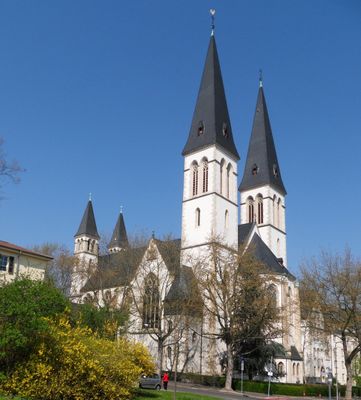
The Dreifaltigkeitskirche is a Romanesque Revival church built 1910–1912 by Ludwig Becker in Wiesbaden's Dichterviertel, on a rise at the southern edge of the inner city. It is a hall church with four towers: the west towers reach 38 m and the choir flank towers 65 m, visible from afar. Its interior was simplified in the 1960s.
The Dreifaltigkeitskirche was built from 1910 to 1912 by Ludwig Becker in the then-new Dichterviertel and consecrated on 29 September 1912. In the night of 2–3 February 1945, bombing during World War II left no window intact. The damaged parts were rebuilt in simplified form between 1950 and 1952, and in the 1960s the interior was simplified again after the Second Vatican Council: the high altar, communion benches and pulpit were removed, and the original paintings were lost. Since 1 January 2012 it has been a filial church of St. Bonifatius.
The church is a branch of St. Bonifatius since the 2012 merger of all inner-city Catholic parishes. Its name refers to the Holy Trinity, and the parish marked its centenary from 3 June to 30 September 2012 with a closing Mass and street festival. The 1976 Hugo Mayer main organ has 23 registers.
The church stands on a rise at the edge of the southern Wiesbaden city centre, in the Dichterviertel quarter, so the west tower and the 65 m choir flank tower are visible from a distance and serve as landmarks for finding the way. The building is a hall church with four towers.
The church was consecrated on 29 September 1912, but most of its furnishings were still missing and the interior painting was only completed in 1925. The bell foundry Otto of Hemelingen/Bremen cast four bronze bells in c′–es′–f′–g′ for it; none of them survives today.
The community of curious travelers
AroundUs brings together thousands of curated places, local tips, and hidden gems, enriched daily by 94,069 contributors worldwide.