Kaiserstuhl, Low mountain range in Baden-Württemberg, Germany
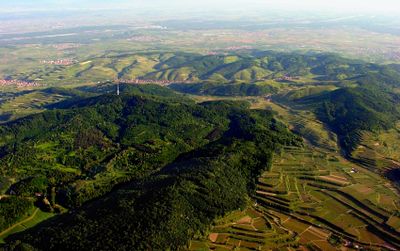
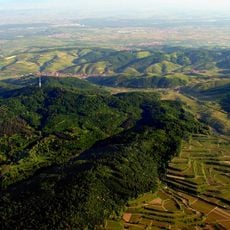
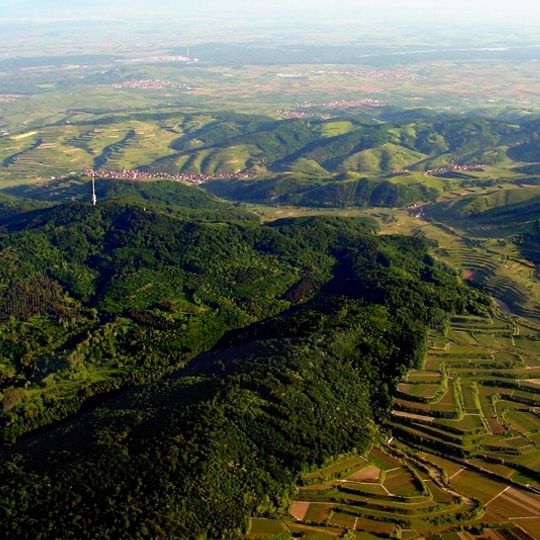
Kaiserstuhl is a volcanic hill range in Baden-Württemberg, about 16 km northwest of Freiburg and directly east of the Rhine. It stretches roughly 15 km from the Michaelsberg near Riegel to the Fohrenberg near Ihringen, reaching 556.8 m at the Totenkopf. Its eastern third is a sedimentary horst, while the central and western parts are eroded volcanic rock.
The name evolved from Königsstuhl following the coronation of Otto III as emperor in 996, who had held court nearby two years earlier. The volcanic soils later attracted winemakers who terraced and planted the slopes over the following centuries.
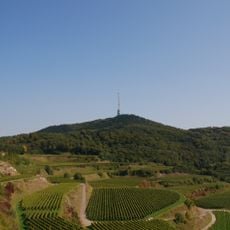
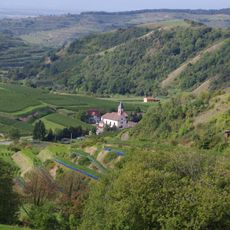
The name Kaiserstuhl, "Emperor's Chair", goes back to King Otto III, who held court near Sasbach on 22 December 994; the range was first called Königsstuhl and became Kaiserstuhl after his imperial coronation in 996, though the name is documented only from 1304. Today the terraced lower slopes seen from the plain are vineyard strips, and the villages around the range, from Ihringen to Riegel, live from winegrowing.
Walking trails wind through the hills and link wine villages, viewpoints and forest sections together. The Breisgau S-Bahn and Kaiserstuhl Railway bring visitors to several starting points around the range.
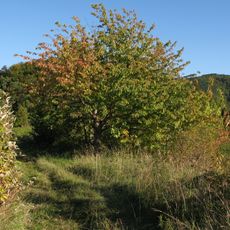
The warm slopes shelter more than 30 orchid species and a southern flora rarely found elsewhere in the region. Praying mantises and sand lizards live here in a climate that recalls Mediterranean areas.
The community of curious travelers
AroundUs brings together thousands of curated places, local tips, and hidden gems, enriched daily by 92,704 contributors worldwide.